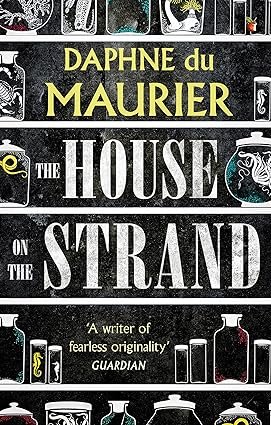
Home » Book Reviews » The House on the Strand by Daphne Du Maurier
Possible spoilers ahead
I am very intrigued to read this book, as I don’t associate this author with time-travel books and I thought it was a mistake when it was first mentioned to me! However, it is indeed a time-travel book so I can’t wait to see how it reads. Grab your copy and let’s read it together!
The narrator is staying at his friend Marcus’ house, called Kilmarth, which is near Par in Cornwall, while Marcus is in London. Marcus is an enthusiastic chemist, and asks his friend if he’d be willing to try a drug he has created in his laboratory at the house which appears to send the user back in time, and the narrator agrees. Marcus explains that he wants confirmation that the drug really does send a person back in time or if he just imagined this when he took the drug himself. Marcus also gives the narrator various bits of guidance for when he takes the drug, warning him that when in the past he won’t feel the ground under his feet or feel inanimate objects and won’t be seen by the people in the past, and adds that if he touches a person in the past then he will be immediately sent back to the present with quite an unpleasant jolt. The narrator takes the drug and the scenery alters and a horseman appears who the narrator follows to a priory of monks, where the narrator learns that the horseman is called Roger, and the monk discusses Roger’s master Sir Henry de Champernoune (who Roger is steward to), and also Sir John Carminowe, and also the forthcoming visit of the bishop. Roger, with the narrator following, then goes to Kilmarth. The narrator reaches out to touch someone in the past and is brought back to the present with a jolt, also feeling quite dizzy and nauseous afterwards, and he also has a cut hand as he had inadvertently put his hand through the glass window of a building in the present. Wow, the story took me a bit by surprise actually as it starts as the narrator enters the past! There is no introduction stating that a drug has been taken and that the narrator is in the past (the explanation above detailing Marcus’ request that the narrator take the drug and what he thinks it does, is all given afterwards), and it took me a while to realise this was happening. I feel a bit like I was receiving a jolt and experiencing confusion similar to the jolt and confusion the narrator received when he came back to the present, and I wonder if the author cleverly wrote it in this way for that reason. And I know Marcus said that the narrator wouldn’t be seen by the people in the past, but Roger seems to look straight at the narrator and even to possibly indicate that he follows him, so does Roger actually sense the narrator’s presence somehow? And it seems to be that Roger lives at Kilmarth (in the past) which is where the narrator is staying at the moment (in the present) so is this creating a link between them, I wonder? I love the cleverness of the narrator cutting his hand because the glass window wasn’t there in the past, I hadn’t thought about all the structures that are there in the present and it’s interesting that these can affect him in the past. And eeek, there is a map, I adore maps in books, and I also love all the Cornish place names beginning with Tre! And it’s interesting how the narrator relays how the scenery has changed in the past from what he is used to, the roads not there and the coastline being different, etc, and it’s useful having the map as this allows me to try and picture things too. I love the descriptive writing of the Cornish scenery, it all sounds such a beautiful area, and I found it interesting that the narrator seems to see things in much sharper detail in the past compared to the present, such as the sky being a brighter blue, I wonder why that is, is it something to do with him just being an observer, I wonder, like he is kind of on the outside of the scene looking in, like looking at a painting? I do love this author’s writing and I always think she takes great care to portray things with her writing so it intrigues me what she is portraying here.
The narrator remembers Marcus’ advice not to drink alcohol for three hours afterwards and adheres to this, though he is greatly shocked and wishes for a drink to calm his nerves and help him process what has just happened. The narrator speaks briefly on the phone to Marcus, who is delighted that it worked and says he thinks that they went back to the 13th or 14th century judging by the clothes the people were wearing, and says that he had also followed Roger and gone to the priory and watched Roger and the monk talk. The narrator’s wife and stepchildren will join him at Kilmarth in about a week, but until then he is on his own there apart from a housekeeper so is free to try the drug again. Hmmm, well so far it’s seeming like the drug does really work and the narrator and Marcus went back to the past! I had kind of wondered if there would be a hint that there was another reason for the narrator’s experience (as I am still struggling to associate the author with a time-travel book!), but with Marcus not sharing what he had seen in the past in order to avoid the narrator being influenced and imagining he saw what Marcus saw, then it does seem to be a fact (well, obviously a fact within fiction, tee hee!). I see there is also a family tree at the back of the book (as well as the map) but it just looks confusing to me at the moment as I don’t really understand the family yet and there seems to be several instances of the same name repeated through the generations, which I know was usual then but for example I’m not clear on which John Carminowe was being discussed by Roger and the monk as there are several of them in the family tree! I love the name of Sir Henry de Champernoune though, how grand that sounds! But speaking about names, I am incredibly frustrated not to have a name for the narrator, it seems rude just calling him ‘the narrator’, and I wonder why the author hasn’t introduced him to us! And as an aside, I loved that the narrator listened to Debussy’s La Mer as he tried to wind down after his experience, as I adore De Bussey.
The narrator decides to try taking the drug outside the house (rather than taking it in the laboratory where both he and Marcus took it before) to see if he has another experience, as he wonders if the drug could have actually created some kind of telepathic connection with Marcus rather than him actually going back in time. He drives to the nearby village of Tywardreath and sits in the churchyard to take the drug. He goes back to the same time in the past, but he is in the priory this time (he had estimated that the old priory would have stood on the site of the present church) and sees the bishop arrive and the local important people being presented to the bishop, and overhears gossip about Sir John Carminowe planning to sleep with Sir Henry’s de Champernoune wife while Sir John’s own wife is due to give birth, and also learns that Sir John supports the priory with money and that Sir Henry is lord of the manor of Tywardreath. Otto Bodrugan is also there, and the narrator learns that his sister Joanna is married to Sir Henry, and he is married to Sir Henry’s sister Margaret. Sir John introduces to the bishop his brother Sir Oliver Carminowe, who seems to be drunk, and Sir Oliver’s wife Isolda, and the narrator hears Roger and Bodrugan discuss their admiration of Isolda’s beauty and the narrator also admires her beauty. The narrator returns to the present but doesn’t experience the dizziness or nausea of last time, and he notes on his watch that 30 minutes have passed. Hmmm, that seemed a slower chapter to read as I got a bit confused with the people again so was flicking back to the family tree to try and keep track of who is who, and I’m not sure which lines mean the people are related and which lines mean the people are married, and all the while I’m also wondering if I actually do need to know and remember who these people are, will their relationships actually be relevant to the story? So are Sir Henry and Sir John cousins, so Sir John is intending to sleep with his cousin’s wife? I also had to flick back to the first chapter to ascertain if Roger was a steward as I first thought, as I can see a Sir Roger Carminowe on the family tree so wondered if this was actually the Roger that the narrator is following, but this Sir Roger is the father of Sir John and Sir Oliver so would then be an older man than I’m imagining, plus would he be gossiping about his son (Sir John) likely to sleep with his nephew’s wife? So I am thinking Roger must be Sir Henry’s steward and so therefore isn’t listed on the family tree. Arrrgh, it is confusing, and as I say I’m not quite sure if I actually need to spend this much time trying to understand who is who, if the story is mostly just going to concern the narrator and Roger. But before I leave my list of puzzles (!), I’m also not quite sure of the size of Kilmarth and if this is Roger’s own house or if it belongs to Sir Henry and Roger therefore lives there because he is Sir Henry’s steward. But apart from all this puzzlement, how interesting that Roger is there again when the narrator goes to the past and Roger again seems to be leading the narrator, there must be some reason for this. And I was also interested that time had moved on in both the past and present when the narrator was in the past, as in some time-travel books I’ve read the time-traveller arrives back in the present and no time has moved on at all.
Now in the present, the narrator asks the priest in the churchyard about the local historic lords of the manor, and is told that the local manor was Tiwardrai, which means the House on the Strand. The narrator is also pleased that this experience with the drug proves that it wasn’t actually a telepathic experience between him and Marcus. On his drive back to Kilmarth, he notices that he feels elation and is surprised at how fast he drives and is then concerned that this elation and confidence could have been caused by the drug and may increase with future uses of the drug and could lead him to do something foolish. He discusses his experience with Marcus, who had also gone to the churchyard and seen a few of the people the narrator had seen and had been guided again by Roger. Oh, I was wondering where the title of the book would come in! And it seems like Kilmarth is Roger’s house, not Sir Henry’s house. It’s interesting that the narrator can’t envisage the old scene of the past when he looks around in the present, due to the scenery and buildings having changed, and particularly as a large part of the scenery would have been under water in the past, which is a particularly fascinating thought. And I was very struck by Marcus’ point of how he and the narrator are able to understand the medieval French the people in the past would be speaking, I hadn’t thought of that, foolishly I had just presumed the people in the past would be speaking the English that I and the narrator speak today! And how clever of the author to deal with this point, having Marcus explain he presumes this is because they are channelling Roger who understands the language perfectly. But again, it’s so odd this connection with Roger, particularly now regarding the language, is it that they are almost reading his mind or possessing his body? I do also wonder where Roger is going to finally lead them, is there a destination in mind that is crucial to the reason why Roger is doing this?
The narrator’s name is given as Richard Young. Marcus says he will get his research assistant to search through historical sources to try and find out more about Roger. Marcus also asks Richard to send him one of the three samples of the drug in his laboratory so he can test it on an animal. Richard writes to his wife to delay her arrival at Kilmarth so he can have more time to test the drug. Richard travels around the area a little, questioning the residents about possible old large houses which could have been the manor house Tiwardrai, and is given three possibilities, Trevenna, Trenadlyn, and Treverran. He also realises that the railway had altered the landscape a great deal, with hillsides being flattened and quarries having been created, so this is also why he is struggling to envisage his images of the past in the present landscape. He also finds a house called Chapel Down and a field called Chapel Park, and decides to take the drug again while sitting beside a small quarry in a field in Treesmill valley. Hurrah, at last we have the narrator’s name, I am so relieved! But I wonder why it took so long to give us this, I’m used to the main character in a book being introduced very early on so I’m intrigued why the author deliberately chose not to do this here. It reminds me a little of her other book Rebecca, where the main character (de Winter’s present wife) was never named, but I presumed that was in order to demonstrate how she felt like a nameless nobody and that’s not the case here in this story, surely. Or is it a hint of how Richard might end up choosing to be a nameless nobody in the past, that this is perhaps where his priority will lay, rather than as Richard Young in the present? And it’s fascinating seeing Richard explore and describe the local area and I’d love to go to the area this is all set in, I am presuming that the village of Tywardreath isn’t actually real but I recognise the names of Par and Lostwithiel and St Austell so if the author has substituted other names for the real villages on the map then surely it would still be relatively easy to find knowing it is all to the east of Par and south of Lostwithiel and also using the railway line as a guide? And I chuckled again at how many of the names in Cornwall begin with ‘Tre’! However, I’m really not keen on this testing of the drug on an animal!
When he goes back to the past while sitting by the quarry in the present, Richard finds that it is six months later in the past. There is a manor house there with a path to the nearby water (as the water came further inland in the past). Bodrugan arrives by boat and goes to the house to be greeted by Roger and they discuss the imminent death of Sir Henry Champernoune who is being cared for at his manor house by his wife Joanna and by Roger and by a monk from the nearby French priory. Sir William Ferrers and his wife Matilda are also there at Sir Henry’s house, as is Isolda Carminowe. Sir Henry dies, witnessed by Roger and Joanna who are the only people in the room at the time, and they agree between themselves that they need to remove the herbs used by the monk to treat Sir Henry before the other relatives come into the room so as to avoid discussion about the treatment, and they also discuss their plan of him being buried at the priory as this means his body can’t be later exhumed. However, Isolda speaks later to Roger saying that she has read a treatise on herbs and knows that ones used for pain relief can also hasten or bring about death if the dose is increased, implying that she suspects this happened with Sir Henry. Richard comes back to the present day, feeling violently sick and very confused, and finds himself in the small quarry, surrounded by gorse bushes and rubbish and slate. He manages to find a path out and stumbles back to his car parked in the nearby layby, being sick several times on the way, and is helped by a local doctor who is also parked in the layby. Oooh, so did Joanna instruct the monk to hasten her husband’s death? Is there going to be a mysterious murder within this book too? But Roger seems to be implicit in this, if that is the case, so we’re now seeing him in a potentially different light, conspiring to help his mistress kill his master! What will Richard think of his guide then, if so? But if they did do this, then why, was it for some monetary gain, or was it so Joanna could be free to have a relationship with someone else (Sir John?), or was it just kindly meant to ease Sir Henry’s pain as he was going to die anyway? And arrgh, more flicking back to the family tree to sort out who all these people in the house are! So Sir Henry’s wife Joanna is Bodrugan’s sister (and I presume she is the woman who Sir John was planning to sleep with). Sir William Ferrers and Isolda Carminowe are (I think!) siblings to each other and cousins to Sir Henry. Isolda is married to Sir Oliver, and he is brother to Matilda (Sir William’s wife). Phew, I’m not finding this family tree particularly helpful as I am still confused at the lines between the people and who are siblings and who are spouses, I’m not very experienced at what the lines in family trees convey.
Marcus sends Richard a document he has found, dated 1329 from the bishop to the monks at the priory detailing attempts to exhume Sir Henry’s body and remove it elsewhere, with the bishop reminding the monks that they must resist these attempts. Richard goes back to the quarry site, after learning from some locals that it is called The Gratten, and realises that the uneven ground is actually foundations of an old house now grown over by gorse, and the small quarry is the result of people digging amongst the foundations for stone and slate to use in later houses, so he guesses that this was actually the Champernoune manor house but he can’t identify from the rubble the rooms he had gone into when he was in the past. Marcus is interested in the severe side-effects experienced by Richard and the time jump of six months, saying he himself hadn’t visited anywhere but Kilmarth and the priory on his trips into the past. Hmmm, is this exhuming because Sir William and his wife Matilda disapproved of Sir Henry being buried in the local priory of French monks, or were tests able to be done on bodies then in order to find out how they died and it is this that they wanted to do? Oh, and Roger’s surname is Kylmerth, so is Kilmarth actually named after him? And it’s quite fascinating that the foundations of the Champernoune manor house are still faintly there (and I presume this is the Tiwardrai manor house which means House on the Strand). And with the local farmer saying that the name of ‘Gratten’ is a Cornish word for ‘burning’, this makes me wonder if the house was deliberately burnt down at some point, and if so then why? This story is becoming quite a little mystery, it seems more than just a time-travel story.
Richard takes the drug again whilst sitting in the kitchen of Kilmarth, increasing the dose as it doesn’t initially work. He goes back to the past and is inside Kilmarth listening to Roger talking to some local farmers about the behaviour of the French monks at the priory and the Bishop’s displeasure with them and also rumours about tensions within the royal family and whose side it might best benefit the locals to take, Roger adding that Bodrugan is favoured by Queen Isabella. Richard also watches Roger quite brutally interrogate a young monk from the priory about information he has heard. Roger successfully encourages the men to side with Bodrugan and Queen Isabella, but Isolda then brings news that Queen Isabella and Mortimer have been taken prisoner and the king is in control, Isolda having taken a big risk by bringing them this news as Sir John supports the king, but she did this because she is in a relationship with Bodrugan, so Bodrugan and Roger are now alarmed at the possible consequences of declaring support for Queen Isabella. Richard comes back suddenly to the present and finds himself having travelled (with Roger and the other men in the past) across the valley and through bog and marsh, resulting in him being soaking wet, and is now outside a house in the village of Polpey. He returns to Kilmarth to discover to his shock that his wife and stepchildren have arrived early to surprise him. Oooh, again, this is fascinating that Richard stayed dry on his walk across the valley in the past because the bog and marsh weren’t there then but as they were there in the present he is now soaking wet! And I’m thinking again how clever it is of the author to have Richard follow one particular character from the past (Roger) and this being a man involved with lots of people, as it beautifully allows Richard to be taken to all these situations which he wouldn’t be part of if he was just wandering aimlessly in the past, pleasing himself where he went. But oh dear, I am lost again with names, this time with who the king was at that time! So his mother is Queen Isabella, who appears to be colluding with her lover Mortimer against her son, and the king seems to be quite young which is giving her and Mortimer the chance to gain control. I think (having broken off from the book briefly to check online) the king at that time was Edward 3rd. I’m also uncomfortable at Roger’s brutality against the young monk who he forces to give them this information, as I’d not imagined Roger could be cruel like that and I’m disappointed in him. But I’m fascinated at the mention of French ships coming up the waters there, that’s an amazing thought! And also at the mention of Lundy Island, as I’ve always wanted to go there.
Richard’s wife and the children go to church, so Richard goes to the quarry and takes the drug, knowing he has an hour or so to himself before he collects them from church. He arrives in the past at the Champernoune manor house. Joanna is away, but Isolda and her children are there, and also Bodrugan who has arrived secretly to see Isolda. Roger (and Richard) eavesdrop on Isolda’s conversation with Bodrugan, she discusses her suspicion that Joanna killed Sir Henry, with Roger’s help, and warns Bodrugan that Joanna could do the same to Sir John’s wife in order to free him so they can then marry, or that Bodrugan’s wife Margaret could do the same to him if she suspected their relationship as Margaret is also advised by the same monk, Brother Jean, who treated Sir Henry. Isolda also urges Bodrugan to be cautious of Roger as he knows of their relationship and could betray them if he wished. Richard goes back to the present, feeling fine this time but is nearly run over by a car as he appears in the present in the middle of a road. He has also been gone for far longer than the time that had seemed to have gone by in the past, meaning he is hours late for collecting his wife and the children from church. He vows to speak to Marcus about this new occurrence of time-lag between the two worlds. His wife had managed to get herself and the children home from church but she is angry at him and scornful of his vague excuses, also having been further angered and made more suspicious by a telegram that had arrived from Marcus which referenced his hope that Richard’s girl turns up (meaning Isolda). Richard manages to pacify his wife, but is all the time thinking in his mind about the past wondering if Bodrugan’s house still exists and where Isolda and her children were travelling to after they left the Champernoune manor house. Omg, that whole journey into the past seemed extremely risky with Richard only having such a short time until he needed to collect his family from church, and given that he has often returned to the present in quite desperate states before (such as being violently sick or soaking wet) and he had given himself no time or space privately to recover, both before he had to collect his family and also at the house with his family there! I was also wondering if he had a way to judge the time in the past, I wasn’t sure if he had actually been in the past for the several hours of time that had gone by in the present but was just so involved in what he was seeing that he lost track of the time, or if (as he thinks) the time now goes by at a different rate between the past and the present. And then there’s the drama of him returning to the present in the middle of a road and nearly getting run over, omg, this is tense to read! It does seem like travelling back in time is like an addiction for him though, making him careless of the consequences in his eagerness to do it. And I wonder what will happen with Richard and his family, as I can understand his poor wife’s suspicions with Richard being gone so often and seeming so distant towards her (as he is always thinking of the past and not listening to what she is saying). I even wonder if Richard cares enough about his life in the present to try and put things right, or if part of him would be willing to have his wife and the boys leave him so he can go back to the past in peace, it seems like the past has more of a hold on him than the present (although obviously anyone would be fascinated with the opportunity to go into the past!).
Richard escapes the family while they are all on a day out together, saying he is going for a walk, and finds Bodrugan Farm, the property has now been altered but there are still signs of the original very large house. He wishes he had some of the drug to take so he could be in Bodrugan’s property with him, but he doesn’t have any. He manages to phone Marcus when they arrive back at Kilmarth, and explains that he can’t do any trips to the past for the moment while his family are there. He also shares how the time between the past and present seemed to differ on his last trip, and Marcus says he will give this some thought. Marcus also says that he will try and come to Kilmarth himself next week. Richard notices that he feels very low and has a bloodshot eye, and wonders if these are side-effects of the drug. Richard is informed by his wife that she has invited some friends to stay, and the day drags for Richard while they are there. When everyone is asleep, he collects some of the drug and drives to the quarry and travels back to the Champernoune manor house in the past. Omg, I was so relieved he didn’t have any of the drug on him when he was at Bodrugan’s Farm and that he had told Marcus he wouldn’t be doing any more trips to the past while his family are there, but already he’s gone back on that! I have such a sense of dread and foreboding now every time he goes back into the past, especially now there are people at the house with him, it just seems so very risky! But I’m also noticing how clever it is having Richard’s family and his wife’s friends descend on him as I was aware I was kind of skimming through these sections as I was keen to get to more of the time-travel but it then struck me that this is also what Richard is doing as he’s barely listening to his wife’s chatter as in his mind he is back in the past wondering what happened to the people there so he’s effectively skimming through the time he spends with his family like I’m skimming through these sections in the book! He’s effectively living a double life with his body in the present and his mind in the past, and having his family there emphasises this beautifully, oooh, Du Maurier is such a clever writer!
In the past, Richard sees that Joanna is there at the Champernoune manor house nursing her nephew Henry (Bodrugan’s son) who is ill with fever, and the monk Brother Jean is helping her. Sir John is also reluctantly in the room, though fearfully keeping his distance in case it is smallpox. The weather is too bad and the river is too high for a message to be sent to the boy’s parents for them to come, but Joanna and Sir John are eager to be gone from the manor house in order to avoid becoming involved in an expected attack by Sir Oliver on Bodrugan over Isolda, so Brother Jean suggests that the boy be moved to the priory where he can further care for him until his parents can take him home. Roger is also apprehensive for Isolda regarding Sir Oliver’s expected attack so sends his brother to tell Isolda to stay inside the house at Tregest, and he then battles through the weather (followed by Richard) to the river where he sees Bodrugan’s ship in difficulties and watches them manage to reach the other side of the bank but then be ambushed and killed by Sir Oliver and his men, who tie Bodrugan’s dead body onto a plank of the boat and set it adrift towards Roger, Sir Oliver shouting to Roger that it is for Isolda with his compliments and he will be waiting for her at home. Isolda appears with Roger’s brother and is distraught at seeing her dead lover. Richard instinctively reaches out to comfort her but as he touches her he is sent violently back to the present, feeling sick and dizzy again. Omg, I wasn’t expecting that, Sir Oliver killing Bodrugan, that was really brutal! Will there be any consequences for Sir Oliver, I wonder, or was it just accepted then that the gentry weren’t questioned about their actions, or at least not questioned if they take revenge against a man who is having a relationship with their wife? That was a very powerfully written passage, with the descriptions of the raging river and storm and the powerlessness of the ship’s crew to steer a course, as well as the powerlessness of Roger to warn them of the waiting gang on the bank, then the brutality of the killings, shiver, I can fully empathise with Richard’s horror and shock!
Richard recovers sufficiently to drive back to the house but is worrying all the time about Isolda and if Roger will be able to help her, then without being able to stop himself he blurts out to one of the guests that he has just witnessed a murder early that morning. He finally realises, to his horror, that the past and present had merged for a while as he was in the present but it still felt to him like the past was real, and he notes this as a new alarming side-effect to share with Marcus, as well as swiftly reassuring the alarmed guest that the police were dealing with the situation. His eye is even more bloodshot and he has frequent sweating fits. He manages to communicate some of this guardedly to Marcus on the phone while his wife is in the room, and Marcus urges him not to take the drug again until he arrives there in a few days’ time, and Richard feels reassured by the fact that Marcus will soon be there. However, Marcus doesn’t then arrive at the house at the time he had arranged, and when Richard goes to the train station he is given Marcus’ suitcase which he had left there with a message for Richard. When Richard opens the suitcase he finds the bottle containing the drug which he’d sent to Marcus, which is now empty, so he presumes that Marcus had decided to take a trip into the past. He also finds information in the suitcase from Marcus’ research assistant detailing that Bodrugan’s son had died from the fever a short time after his father had been killed, and that Sir John had also died, presumably from the fever caught from the boy. Omg, yet more tension! I was flinching when Richard was blurting out about the murder to his guest and how he couldn’t seem to stop himself from talking! And Richard’s other side-effects of sweating fits and a bloodshot eye are concerning too, as well as the way Richard seemed unable to distinguish between the past and the present! Oh dear, what has he got himself into? I am beginning to worry quite a lot for him and don’t want him to have damaged his health by taking this drug, and I’m even beginning to wonder if this merging of the past and present might mean that he becomes trapped in the past or loses his mind in the present, eeek, Du Maurier has written her characters so well that I can’t help caring for them!
Marcus is eventually found dead beside the railway line after being struck by a train, though the police can’t understand how he didn’t hear or see the train coming but Richard realises that Marcus had been walking in the past so therefore didn’t see or hear the train in the present. Richard is asked to identify Marcus’ body and the police tell him there will be a post mortem and he will be called to the inquest. Omg, omg, omg, I can’t believe that Marcus is dead! I was racing through those pages, caught up in Richard’s anxiety about where his friend could be but was totally unprepared for him being dead!! And for poor Marcus to have been struck by the train while he was walking around in the past so completely unaware of the danger approaching, eeek, that’s such an awful thought! And makes me realise how lucky Richard has been up to this point not to have been injured himself, which makes me want to reach into the book and shake him to convince him never to take the drug again now he can see the danger of it, as well as the fact that he is now entirely on his own with no-one to share his experiences or concerns or side-effects with so that makes it more dangerous to take the drug again, and that he also won’t ever know what Marcus had surmised about the drug and how it works…but I feel equally certain that he won’t be able to resist taking it again! I’m fascinated again at Du Maurier’s wonderful writing though as she laid the groundwork for this so beautifully by having Richard cut his hand by inadvertently putting it through a glass window in a building in the present and also with him getting soaking wet walking through a bog and marshland which weren’t there in the past, she has basically dropped great big fat hints to us that something like this would happen but of course I didn’t see it! I am full of admiration for these little clues she gave earlier that this would be such a crucial defining part of the plot, wow! And I was just thinking of how I’m reeling from such a dramatic few sections of the book with Bodrugan’s murder and then Richard blurting out to his guest about the murder and now Marcus’ death, and it made me wonder if there is some significance to Bodrugan and Marcus both dying in fairly close succession (well, fairly close succession in Richard’s life, not in real time as obviously they are 600 years apart!). Was Bodrugan an influential figure in Roger’s life, like Marcus was an influential figure in Richard’s life, so both men are now without the people who they relied on and are now effectively alone in their decision-making, so did these deaths occur to link the men further together? In fact, that makes me wonder (quite alarmingly) that if Richard hadn’t witnessed Bodrugan’s death, would Marcus perhaps not have been killed, eeek?! Or perhaps I’m getting too deep into all this now and looking for extra twists which aren’t there, but I know how Du Maurier can bring a psychological element into her wonderful books as well as a mysterious element! But back to Richard, I am slightly alarmed at him being told he will need to speak at the inquest as I wonder if he will manage to keep it together and not blurt out anything about what Marcus was really doing, surely the strain of all this must be getting to him. I also feel such a foreboding that the police could suspect Richard as somehow being involved in Marcus’ death, just because they will sense he is concealing something and he won’t be able to give any explanation to defend himself, or at least any explanation which will be believed. And I’m also slightly alarmed about the post mortem, as what if they find traces of the drug in Marcus’ body? In fact, I’m just in a constant state of alarm whilst reading this book, tee hee!
Richard receives a letter from Marcus, posted when he changed trains at Exeter station, detailing how the drug works on the brain cells that deal with memory and says the drug allows the older brain memory to take over. He adds that the drug is dangerous and could be lethal if taken to excess and could be used for sinister purposes if it falls into the wrong hands so he urges Richard to destroy the rest of the drug and everything relating to it at Kilmarth if anything should happen to him. Richard destroys and buries the contents of Marcus’ laboratory, but keeps the rest of the bottle of drug he has been using, and also keeps the other bottle which was stored in the laboratory. Marcus’ will is read and he has left Kilmarth to Richard, to Richard’s surprise. Oh dear, this makes me nervous again, that it might seem to the police like Richard had something to gain from Marcus’ death so then was involved in his death in some way! And I was really hoping that Richard was going to destroy the bottles of drugs, sigh, I’m so disappointed that he didn’t (though I feel it was inevitable that he wouldn’t do that as that wouldn’t be much of a conclusion to the book, tee hee!). But I don’t like him taking this other bottle which was stored in the laboratory, as it occurs to me that Marcus might have slightly altered the drug in each of the three bottles, perhaps altering the concentration of the ingredients and therefore the power of the drug, so who’s to say what side-effects Richard might experience from the other bottles if they aren’t exactly the same?! And I don’t quite follow what Marcus is saying about the older brain memory taking over, as where have these memories come from, and why would Marcus and Richard have the same memories? I can perhaps see that one of them could be distantly related to Roger (Marcus would be the most likely one as it has been mentioned that Kilmarth was his childhood home so perhaps that was because his family came from the area) so perhaps if Roger’s genes run faintly through that person then perhaps some of Roger’s memories do also? But they can’t both be related to Roger, so how can they both have had the same experience with the drug and both seen Roger? Or is it all hallucinogenic and they don’t travel back to the past at all? But then I’m brought back again to why they had the same experiences without having shared beforehand what they experienced? I can see that if Marcus hallucinated after taking the drug and spoke to Richard about Roger, then Roger would be in Richard’s memory cells so when he hallucinates after taking the drug then he could see Roger too, but that didn’t happen, Marcus didn’t tell Richard about Roger purely in order to avoid that happening.
Richard goes to the area where Marcus was found and takes the drug. He arrives in a snowy scene in the past which surprises him as when he was last in the past it was autumn time so he realises that time has moved on again. Sir Oliver is hunting, and Roger appears and chats briefly to him, with Sir Oliver making dismissive comments to Roger regarding Isolda and Joanna and Bodrugan. Roger (with Richard) follows Sir Oliver to his house, saying he has a message from his mistress Joanna for Isolda. When Roger meets Isolda, alone in her room, she says her husband keeps her a prisoner there and he tells people that she is ill in mind and body. Roger says he will help her escape so she can go to her brother Sir William, adding that she can break her journey at his own house before she continues on to her brother. She climbs out of her window and meets Roger (with Richard) in the nearby woods. Richard sees another man appear, who he presumes is Roger’s brother, who helps Isolda across the snow with Roger. Some instinctive feeling then stops Richard from proceeding any further along the path, and he comes back to the present time and finds himself right next to the railway line just as a train is passing, and is very shaken. Omg, all the time that blooming railway line was in my mind! I was hoping that Richard had devised some kind of mental map so he knew roughly where it was in the scenery of the past so could avoid it, but I was panicking further as he began walking as he didn’t seem to be referring to the railway line in his mind, eeek! But thank goodness, some kind of instinct seemed to warn him about the railway line. I wonder if the other man that Richard saw in the snow wasn’t actually Roger’s brother but was Marcus now stuck in the past and perhaps the instinct that stopped Richard from moving onwards onto the railway line was actually some sign from Marcus? I’m also wondering now how this story will end and I can’t help coming back to the dreadful railway line in my mind, will Richard actually be killed on the railway line, as Marcus was? I’m kind of feeling (though very reluctantly) that the conclusion must be Richard dying as then the knowledge of the drug conveniently dies with him. As an aside, when Sir Oliver mentions Joanna scornfully to Roger, this made me remember that Joanna was Bodrugan’s brother so surely she is grieving for him, as well as Isolda grieving for him, but arrggh, looking at the confusing family tree again I can’t work out what relation Joanna is to Sir Oliver, the man who killed her brother. And I was worrying about what Isolda was suffering at Sir Oliver’s hands since Bodrugan’s death, poor woman, and clearly she has been made to suffer, Sir Oliver really seems like a horrible man! But phew, at least she has escaped, though this was yet another tension-filled section as I was willing her to escape but also half expecting her to be caught as she was escaping, wow, Du Maurier really does write a nail-biting tale!
Richard returns to Kilmarth but can’t stop thinking about Isolda having been there at this house too with Roger, as she broke her journey at Roger’s house that night on her way to her brother. These constant thoughts result in him becoming even more detached from his wife and her becoming suspicious and annoyed at him. The following day his hand becomes numb. He also discovers from looking at a book about the area that Isolda’s home with her husband, called then Tregest, is now the farmhouse Strickstenton. It is the inquest and Richard speaks about Marcus’ interest in the history of the local area as a reason for him to have been walking around the countryside at night and his careless disregard of danger, and he is backed up in this by Marcus’ chemist assistant. The chemist assistant clearly knows something about the drug and afterwards says to Richard that he hopes all of it has been destroyed. Richard has further disagreements with his wife, as she suggests they leave Kilmarth and build a life elsewhere but he wants to stay living in Marcus’ house. Oh no, I don’t like this about his hand going numb, that doesn’t bode well! And is it a good or bad thing that Marcus’ chemist assistant seems to know a little about the drug? I guess it would be good if Richard had admitted to him that he still has some of the drug so the chemist assistant could then perhaps test it to see if it is dangerous or share more of Marcus’ findings with Richard, but it could be bad if the chemist assistant speaks to anyone else about the drug or even tries to hold his knowledge of it over Richard. However, I could probably dismiss both of those suppositions, as Marcus has already told Richard that the drug is dangerous, and who would believe the chemist assistant if he told anyone that there is a drug that sends you back into the past! And it all seems to be getting worse and worse between Richard and his family, he is certainly now caring more about the people in the past than about the people in the present, sigh, I feel like I am gradually watching everything disintegrate around him, and it’s difficult to witness as I do care about him! And I see that Strickstenton is on the map in the book, and eeek I’ve just looked on google maps and all these places are real, wow!! I can see Strickstenton Farm and Tywardreath village and Treesmill Farm, there is actually a property (and quite a large bit of land) where Kilmarth is on the map in the book! Omg, I could actually go to these places myself, well, obviously not go right to them as they are private properties (!), but just to be in the area itself would be incredible, though I wonder how many other people who have read this book have gone to the area and what the locals think of it all! Anyway, I am letting myself get distracted because (I suspect) I am avoiding going back into the story and witnessing more of Richard’s disintegration (and, I fear, his possible death)! But deep breath, on I must go!
Richard’s wife and the children go out for the day so he takes the drug but it is from the bottle he’s not used before. However it doesn’t seem to work at all so he takes more of the drug but it still doesn’t work. A few hours later it still hasn’t worked and he drives near to Treesmill wistfully thinking that he will never go into the past again, and then there is a sudden blast of pain and he is in the past. Roger is speaking to a companion about having been sacked from his steward’s job by Joanna, though he seems confident of being reinstated when her son comes of age. A crowd has formed to witness the public shaming and penance of a local widow who slept with another man only six months after the death of her husband, and Roger discusses with his companion that this punishment was organised by Joanna and he thinks his protest at this contributed to Joanna dismissing him, as well as Joanna’s suspicion that Isolda has been living at Roger’s house for several weeks. After the public shaming, Joanna asks Roger to let her see Isolda, saying she has a message for her from Sir William. Joanna suddenly seems to gesture to Richard to join her in her carriage, but he is just as suddenly shot back to the present standing beside a road, and his wife and the children are beside him in the car. His wife suspects Richard is drunk, as they saw him stumbling around and he didn’t seem to be aware of them at all even though they were calling to him. He goes to bed but then wakes a few hours later and is in the past again watching Isolda speak to Roger’s brother, though he has not taken any more of the drug and can also hear his stepchildren’s radio playing so he realises that past and present have now merged. Omg, what is happening? He is in both the present and the past simultaneously, this is awful, and he seems to have no control over when he goes into the past as he hadn’t taken the drug again! Stupid stupid man, I knew him taking the drug from that other bottle was a bad thing to do and then he goes and takes more and more of it as it didn’t seem to be working, arrggh! But I was puzzled at Joanna seeming to gesture to him, what could this mean? Has he taken on the form of Roger now, was it Roger that Joanna was seeing but it was really Richard inhabiting Roger’s body? Is this why he is stuck between the past and the present as he now exists in both, in the present as himself and in the past as Roger?!
In the past, as Richard watches, Joanna speaks to Isolda saying she is bringing a letter from Sir William stating that he has just learnt of Isolda leaving her husband and he wants to express his shock of this news, and he adds that he can’t house her because his wife is Sir Oliver’s sister and she has taken her brother’s side, so he suggests that Isolda goes instead to a nearby nunnery. Isolda refuses this offer, and Joanna then scornfully accuses her of having a relationship with Roger and threatens to have her dragged before the public and face the shaming that the local widow recently faced, though Roger declares he and his brother will defend Isolda. Joanna then stares at Richard, and he steps towards her and puts his hands around her neck in his anger at her threats to Isolda, but he suddenly returns to the present to find he is strangling his wife. Omg, this just gets worse and worse, I had never imagined this happening, Du Maurier is certainly laying on the dramatic twists and turns! I can’t see how Richard can possibly explain his way out of this! And also how will it all end, could he go back to the past again at any moment whilst he is still interacting with people in the present, how many more times will this happen before the drug wears off, if indeed it ever will wear off? And has Richard’s wife kind of morphed between the past and present too, morphing into Joanna in the past like Richard had seemed to morph into Roger in the past? And if so, then when Richard thought Joanna was gesturing to him to join her in her carriage, was it perhaps his wife gesturing to him to join her in her car? And obviously then this has all developed very dramatically and tragically into him thinking he was strangling Joanna in the past but was actually strangling his wife in the present! However, it strikes me that his wife is the woman in the past who he doesn’t like (Joanna) rather than the woman he does like (Isolda), that is fascinatingly significant, I feel!
His wife and the children run and lock themselves in the bathroom, and in shock at what he’s done Richard calls the local doctor and tells him he has just tried to strangle his wife. The doctor swiftly arrives, and examines her and pronounces her to be fine with just a few bruises. The doctor then speaks to Richard, who tells him outright about the drug and that he has travelled into the past and that he thought he was strangling Joanna from the past, adding his feelings of horror at what he has done to his wife and assuring the doctor that he will never take the drug again and hands over the remainder of the bottle to him. He is put into a sedated sleep by the doctor which lasts five days, and when he comes round the doctor says he has had the drug analysed by Marcus’ chemist assistant who says that it contains a powerful hallucinogenic and that Richard is lucky to be alive. The doctor adds that during his sedated sleep and wakeful moments Richard had spoken at length about the characters from the past, and the doctor insists he can therefore link it all to Richard’s Catholic upbringing as well as his anxiety about possibly having to live in America with his wife, so the doctor believes the imagination of the past then seemed a safe alternative to Richard. Richard tries to convince the doctor that he really did travel to the past, adding that there is documentary evidence of these people in the past. The doctor advises him to go on holiday with his wife and stepchildren, which Richard agrees to do, though he first contacts Marcus’ research assistant who tells him that he has discovered that Sir Oliver secretly married his daughters’ governess, presumably in haste after Isolda’s death and perhaps because the governess was pregnant. Oh, so the doctor doesn’t believe that Richard travelled to the past! I have mixed feelings about this really, as if the doctor did believe it then things can’t just end there, this invention would surely need to be shared more widely and then there would surely be possible dangers with sharing it. But as the doctor doesn’t believe him, this makes me worry that Richard could be determined to prove the doctor wrong and also to prove to himself that he really did go into the past so then would be tempted to try and go back again. I’m bearing in mind that Richard has Marcus’ walking stick where Marcus had stashed the drug in its hollow top, so I really hope there aren’t any dregs of this left in that hollow top that Richard would be able to take again, or that there is any more of the drug which he has secretly kept (there is still a chapter to go, after all…!). And Richard now knows that Isolda did die, because her husband was then able to re-marry (well, obviously she must be dead as it’s 600 years ago, but it seems like she died quite young), and I fear he could be desperate to find out how and when she died so will go back into the past to discover this. Although I am taking comfort from the fact that can’t he convince himself that he can save her from dying, because he always goes forwards in time and never backwards. And he could just find out about how and when she died through historical research, he wouldn’t have to travel back to the past to find that out (though I fear my hope of him choosing this option is probably foolish!). And although I don’t want him to go back into the past again, with the risks that this involves, I am curious to know if he did actually go into the past or if it was just a hallucination like the doctor thinks, and I wonder if we are going to get an answer to this! But then I keep thinking how can it have been a hallucination when it has been proved that these were real people from the past and Richard hadn’t learnt about them beforehand. But phew, to be honest, I am still reeling from what happened with Richard’s wife and my relief that she was ok and that Richard isn’t going to be imprisoned or placed in a lunatic asylum for her murder!
Richard is at the airport with his wife and stepchildren just about to board their plane for their holiday in Ireland, when Richard says he needs the toilet so tells them to board without him and he will squeeze in at the back of the plane and join them when they have taken off. But he actually goes out to his car and drives back to The Gratten, determined to take the drug one last time as there is a measure of it in the hollow top of Marcus’ walking stick, and he takes it just as he arrives at The Gratten. He then sees the doctor there at The Gratten, as the doctor had guessed just what Ricard would do. The doctor begins to tell Richard that he has received a further report from Marcus’ chemist assistant which says that the drug contains something toxic which can cause paralysis, but as the doctor says this Richard goes into the past. Omg, nooo, I can’t believe Richard has done this, deviously lying to everyone and clearly always planning to take the drug again, sigh! Silly silly foolish man, this won’t end well, I know it won’t, and I feel gutted as it was a happy ending in the last chapter so how I wish I’d stopped reading there (!), as I feel certain that there is no way that the author will give us another chance of a happy ending and I so wanted Richard’s life to end well, sigh! And omg, the paralysis sounds bad, eeek! I hardly dare turn the pages further, I don’t want to see it all go wrong! And how significant that the doctor had viewed Richard as just another drug addict and so therefore saw through his assurances that he’d never take the drug again and he was so certain of this that he went to the site to wait for Richard, that must have been very sobering for Richard to be viewed (and effectively proven) as just another drug addict, as he has all these noble high ideals about what his purpose is in going back to the past and had presumably justified his devious actions in his mind by thinking about his noble high ideals. However, although I’m horrified that Richard is going back into the past again, part of me is interested in what the doctor will witness and if he might be convinced that what Richard has said is true, and this will give us an answer as well.
Richard arrives in the past at the Champernoune manor house, where Sir Henry’s son William is now an adult with children, so Richard realises that he has gone forwards about 12 years from his last visit to the past. There is no sign of Roger, but Roger’s brother arrives and asks William about the family’s health and they also discuss the health of the village inhabitants, and Richard realises that the Black Death plague has arrived in the area. Richard follows Roger’s brother back to Kilmarth, where Roger is sick and at the point of death. Roger confesses to his brother (with Richard listening) that he had killed Isolda 13 years ago because she was sick and as he loved her he didn’t want her to suffer for months before she died so he gave her some of the monk’s drugs. Roger’s brother briefly leaves to get something to cover Roger with to make him more comfortable, but Richard stays with Roger. As Roger dies, he looks directly at Richard and Richard says a prayer for him. Richard then wonders if Roger’s desire not to die alone and to be absolved of killing Isolda had driven him to travel through the years to seek out someone (Richard) to provide this comfort. Richard then comes back to the present, in the laboratory at Kilmarth, with the doctor watching him. Wow, that was yet another powerful scene! Firstly the Black Death in 1348, eeek, and then the shock that it was Roger who had killed Isolda, though through love and kindness, and I didn’t see that coming at all, I was presuming she had been killed on Sir Oliver’s orders! But at least now Richard knows what happened to Isolda and can hopefully be comforted that she didn’t suffer. I wonder what that sickness of Isolda’s was though, as Roger implied (if I understood him correctly) that his mother had also suffered from it, or did he just mean that his mother had suffered another type of illness and it was heartbreaking watching her suffer and to be unable to help so this made him determined to step in when he saw another woman he loved suffering? And thank goodness, Richard has made it back to the present, phew, I was so fearful that he wouldn’t and would be stuck forever in the past! Hopefully now with him knowing what happened to Isolda, and with Roger (his guide) also being dead, and him helping Roger die peacefully, then he won’t feel any more urges to go back into the past, he will feel that he has completed what he needed to do. Though that makes me wonder if Richard could actually go back to the past now, even if he wanted to, without Roger being there to lead him? However, I’d prefer it to be Richard’s choice not to go back to the past, as opposed to him being physically unable to do so as I can imagine that might torture him, whereas if it’s his choice then I can imagine him being more content and calm about it. But anyway, I must stop speculating and read on to see! And of course I’m aware that this is me clearly believing that the journeys to the past are actually true, tee hee, so I guess it will be interesting to see what the doctor now thinks from what he has witnessed.
Richard tells the doctor that it is all over now as Roger is dead so he is now free, and he also shows the doctor the empty hollow top of Marcus’ walking stick, explaining that the drug was stored in there. The doctor tells Richard that he waited with him at The Gratten and then followed Richard as he walked to Kilmarth and then watched Richard kneeling while saying a prayer. The doctor adds that he burnt the report of the drug at the moment when Richard was saying the prayer, and he refuses to tell Richard what else the report said. The phone then rings and Richard goes to answer it, saying it will be his wife and he must now arrange to meet them in Ireland, but the doctor suggests that Richard tells his wife that it will be a few weeks before he is able to join them all in Ireland. Richard then finds he can’t pick up the phone as his hand has gone numb. Arrrgh, this is the end! Omg, so I’m guessing that the report said that the paralysis would lead to death in a few weeks, which is why the doctor advised Richard to say it would be a few weeks’ time before he joined his family, so he can die there at Kilmarth without his family witnessing it! Oh noooo, I knew I should have stopped reading at that penultimate chapter, I am so sad now that there is no happy ending for Richard!
I do wonder about Richard’s death though, was it caused by this final taking of the drug (ie, was it an accumulated effect as Marcus seemed to imply when he said that taking it to excess would be dangerous, or alternatively did this bottle contain a different mix of the drug which was more lethal), or was he always going to die eventually because the first time he took the drug it caused him damage right from the start? I guess it doesn’t really matter, it’s just hard thinking that it could have been caused by him taking the drug that final time as that makes me feel even more frustrated that he took it, whereas if it was inevitable he would have died anyway from the earlier takings of the drug then him taking it that final time doesn’t really matter in the scheme of things so I can feel slightly less frustrated at him. But then when I think about his death I am struck by another thought, was it not really the drug that killed him but that he was fated to die because he saw Roger die, they were connected so when one died the connection was broken so the other must die? Obviously we know that Roger was dead when Richard first saw him as it was 600 years ago (!), but I wonder if the actual witnessing of him dying and being there at the end made some kind of a difference, which if so then this makes me frustrated all over again at Richard taking the drug that final time as if he hadn’t witnessed Roger dying then perhaps Richard wouldn’t have died? I know Marcus also followed Roger so had a connection with him, but it was obviously Richard who had the greater connection with Roger (or indeed, as I wondered, even kind of became Roger), as Richard had travelled back to the past and seen Roger far more times than Marcus had, so if Roger was indeed looking for someone to form a connection with to help him peacefully die then it’s tempting to think this person ended up being Richard as opposed to Marcus, as Marcus only saw Roger two times. Or (another theory!) was Richard fated to die the moment the balance of his life (and mind) became more in the past than in the present, so as the two worlds were beginning to merge did the balance tip in the favour of the past so then he had to die in the present? Arrrgh, I think I’m just tying myself up in knots here, I clearly am becoming obsessed by this book and the characters in it, whilst all the time knowing that I will never know these answers for sure as the author has annoyingly not provided any further answers! I do wonder how she viewed it all in her mind.
And, groan, we don’t have any answer about if Richard actually went back into the past or not, was it real or just a hallucination? I had such high hopes of the doctor being able to answer this by him witnessing Richard in the present whilst he was in the past but we didn’t get that, the doctor did seem quite subdued though so was that from shock at his realisation that the time-travel was true, or was it because of what he knew the drug would do to Richard? He doesn’t actually state again at that moment that it was all a hallucination, in fact he doesn’t really say much at all, so does this mean he is now convinced that it was true and Richard did go into the past, or does he just feel there is no need to repeat what he has already stated about it being an hallucination, particularly as his main concern was likely to have been how he could best help Richard in his last few days or weeks?! Arrgh, again, will I ever be able to stop thinking about this book?!
Omg, what a book, so extremely powerful and thought-provoking, and leaving us with an enticing mystery at the end too, as well as leaving us (well, definitely me!) with great sadness over Richard’s likely fate! Phew, I feel quite drained with it all! What a remarkable tale Du Maurier came up with, it was an absolutely amazing read, so very gripping, and so very different both from any other book I’ve read of hers and from what I’d imagined was this author’s usual style. There was a fantastic mix of detail from the past and present, a great blending of the two with believable characters in both who she encouraged me to care for. And eeek, I’ve just been looking on Wikipedia and I see that some of the people in the family tree are actually real (!) so I’m struck with how her level of research must have been incredible too. I also love again that this is all set in a real area that I could visit! But wow, I think it will take me some time to process everything in this book, what a great read!
I now want to read some of Du Maurier’s other books that I’ve not yet read ,as I wonder if she has also explored other subjects which are different from what I’d presumed her usual books were. And omg, I have just seen that she wrote The Birds, I remember watching Alfred Hitchcock’s terrifying film of this but I hadn’t realised it was her book, so again this seems very different from her usual subject matter, I will have to read that next! The Scapegoat also sounds interesting as it’s about a stolen identity. And oh my goodness, Rule Britannia sounds very appropriate for what has actually happened as its theme is England leaving the EU, wow! I also have a book I’ve been meaning to read which is set in the 14th century, Katherine by Anya Seton, so it might be interesting to read that seeing as I’ve just been in the 14th century with Richard.