Home » Book Reviews » RF Kuang » Babel by RF Kuang
Possible spoilers ahead
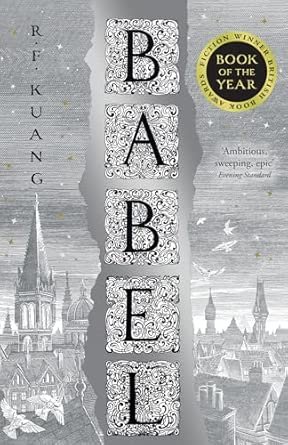
This was someone’s choice in my bookclub group for us all to read, and I am very much looking forward to it! It seems to be a huge intricately detailed book so something really involving and delicious to fully absorb myself in, and I always imagine that large books like this have been a labour of love for their author and they must have conducted lots of research, which I always respect. So grab your copy and let’s read it together!
Already I am charmed by the first introductory pages, before I’ve even begun the story, tee hee! I like that the tale is titled ‘an arcane history’ and it’s set in Oxford too, and with a map of Oxford, yay, I do like it when a map is provided in a book, and the map is beautifully drawn and detailed, I just wish that I knew Oxford well enough to see if there are many differences to the present day. Oh, though then I see there’s a cross-section of a building called Babel, which was on the map of Oxford, so I’m imagining that’s certainly not a real place that is in present-day Oxford! And the drawing of the building of Babel is also beautifully intricate, and it looks like such an interesting building too with each floor dedicated to a different topic/workplace, such as Literature, and Translation, and it looks a lovely ornate building as well. Oooh, just from the care taken with these lovely drawings of the map and the Babel building reinforces my earlier belief that this is a novel greatly cared about and treasured by the author, which bodes well for my enjoyment of it, I feel. I’m also intrigued by the subtitle of a translators’ revolution, as I’m now wondering what translators would need to revolt against as I’m thinking The Royal Institute of Translation at Oxford University would be a delicious place to work, and I particularly love that it has a coat of arms (which has birds on it which I don’t recognise so I wonder what kind of birds they are). I am slightly daunted by the words ‘The Necessity of Violence’ though, I hope it’s not too violent as I am a bit of a wimp! I like the author’s foreword too and the reasons she gives for the alterations she has made to Oxford in her book, and she clearly loves the real Oxford a great deal so I like her for this as well, as I’m sure Oxford is a place which inspires great adoration and loyalty from people who know it well with all its beauty and history and traditions, and I also liked the sound of the cafe in Oxford that she mentions favouring with its scones she enjoyed eating, and if I ever get to visit Oxford then I’ll definitely have to visit that cafe! I also love (omg, so many things to love already, I can’t think of another book I’ve been enamoured of so immediately!) the list of books she used to research Oxford and life at that time, and there’s quite a few of them I’d fancy reading myself. And she says her tale is set in a fantastical version of Oxford in the 1830s, so that sounds exciting as the word ‘fantastical’ implies magical to me, and I love a story about magic.
Professor Richard Lovell collects a boy from a plague-ridden house in Canton, China, in 1829, where all the other occupants of the house have died and the boy is close to death himself. Professor Lovell places a slim silver bar in the boy’s mouth which saves him from dying, and then takes him away to a place called the English Factory where he recovers after being nursed by a Scottish lady called Mrs Piper. The boy only has four of his favourite books as his sole possessions, and these are books in English which he received in the post twice a year from Hampstead, England, since he was aged four, and has read over and over again. Professor Lovell urges the boy to practice the English he had learnt during his life, courtesy of Elizabeth Slate who lived in the boy’s house (but who has died of the plague, along with the boy’s grandparents and mother). Professor Lovell shows the boy the silver bar again and the boy recognises it as a ‘yinfulu’, a Chinese talisman, but it has words on it in both Chinese and English which read ‘To accept without thinking’. Professor Lovell places the bar on the boy and the bar then begins humming and the boy feels like he is choking, until Professor Lovell takes the bar away and the boy then tastes dates in his mouth. Professor Lovell says he has never seen such a strong effect before with a bar, and so because of the boy’s ability with the bar he offers to be the boy’s guardian and take him to London where he will study a language course focusing on Latin and Greek and Mandarin. Professor Lovell urges the boy to consider the offer overnight and to study the contract he gives him. Professor Lovell also asks the boy to choose an English name, and he chooses Robin Smith. Robin notices that Professor Lovell’s voice has no emotion at all, and he struggles to gauge Professor Lovell’s feelings. Eeek, well, that was quite a dramatic beginning, with Robin being the only one in the house still alive! And what is the slim silver bar which seems to save Robin from death, and the treacley flavour he tasted in his mouth, and there is also Professor Lovell’s surprise at Robin’s reaction to the second bar he places on him. I presume that Robin is going to be a translator, but I wonder if he was chosen at random for this role and sent the English books and Elizabeth Slate to teach him, or did he show some kind of inclination towards languages which somehow alerted Professor Lovell to his skills and Professor Lovell therefore then sent the books and Elizabeth Slate to Robin in order to further develop these skills? And is it just the ability to speak English that Robin is valued for, or is it also for his ability to speak his native language, or indeed can he speak lots of different languages? And what is this English Factory, and is it in Oxford and Robin was somehow swiftly (perhaps magically, going with the ‘fantastical’ word earlier?) taken there, or is it in China? And I’m intrigued by Professor Lovell’s emotionless voice when he speaks to Robin, particularly as Robin is a young boy who has been through the trauma of losing everyone he knows and being uprooted from his home (even though his life was saved by this), as I’d naturally presume that his rescuer (and future guardian) would show some empathy and sensitivity to this, but is this lack of emotion a deliberate choice in order to perhaps avoid building a relationship with Robin or leading him to decide a certain way about whether to go to England? It’s very clever writing though as even I am finding myself distanced from Professor Lovell by his manner as I have been torn with what to refer to him as in my notes, as I began by calling him ‘Lovell’ (as I usually choose to refer to adult males in my reviews by their surnames, particularly in books set in an older time as this is how they seem to be referred to by their associates) but then somehow this felt too familiar for such a remote figure so I have switched to calling him Professor Lovell as the title just feels more fitting, more respectful of the distance between him and Robin (and myself). Oooh, it’s all feeling quite mysterious to read, especially as I feel like I’ve been dropped straight into the middle of everything without any background information!
Robin and Professor Lovell and Mrs Piper leave on the boat for England. Professor Lovell tells Robin that he had arranged for Elizabeth Slate to live with Robin’s family for all those years, but doesn’t explain why he did this. He says that he’d known Robin’s mother so therefore knew their address in order to send Elizabeth there, though he doesn’t explain how he knew Robin’s mother but adds that he knew her when the family used to be better off and lived on an estate in Peking with servants and a cook, adding that the family’s money had been squandered by Robin’s uncle in opium houses shortly after Robin was born and the family property was seized by debtors. He adds that Robin’s uncle then disappeared, leaving Robin and his mother and aunts and grandparents to fend for themselves. Mrs Piper later tells Robin that Professor Lovell is part of the Royal Asiatic Society, and has brought back old scrolls and books from this trip which he will be translating into English on the journey home. Ooooh, I liked the nautical language used to describe how Robin feels leaving his home country, ‘as if a grappling hook had yanked his heart out of his body…this terrifying un-anchoring from all he had ever known’, these are very emotive words that describe his feelings beautifully but I also like how they tie in so neatly with his journey by sea too, that’s very cleverly done, I am excited by this author’s use of language! I also liked the description of the water, ‘the ceaseless waves changing colour with the sky’, that’s lovely! But poor Robin, it must be a wrench not just leaving his hometown and country but also knowing that he has no relatives either, and yet this must also be mixed with some excitement about his new life in London, and also mixed with his feelings of deference and gratitude and a wish to continually please his new guardian who is all Robin now has in the world (along with Mrs Piper, who at least seems a kindly lady), and this wrench from his home and the shedding of his old life seems to be further emphasised by Professor Lovell requesting that Robin speaks only English, no Chinese at all, which must add to his trauma and feelings of isolation from all he has known, so that’s a lot of emotion and feelings for a young 11 year old boy, bless him! And I wonder if there will be more about Robin’s uncle, as if he is still alive then this is one actual relative that Robin has, even though he clearly was (at least from what Professor Lovell says) an irresponsible person so probably not a good person to potentially care for Robin, but still he is someone who is connected to Robin. Oh, in fact, I wonder also about Robin’s dad, as he wasn’t mentioned by Professor Lovell as living in the family home after uncle abandoned them all, so where is he, is he alive, and is he someone who could potentially be another connection or carer for Robin (I can tell I’m already doubting Professor Lovell’s ability to care for Robin and am therefore busy looking for alternatives for him, tee hee!)?
The boat arrives in London, and Robin is overawed at the city but also struck with its contrasts of ‘unimaginably rich and wretchedly poor’. Professor Lovell explains to Robin that London has made its fortune due to silver, and points out a silver bar embedded in the floor of the carriage they are travelling in, saying that it represents speed of ‘hope, fortune, success, and reaching one’s goal…(and) makes the carriages run a bit more safely and quickly’. Ooooh, it’s interesting that London in 1829 is described as being ‘the largest and richest city in the world’, I guess perhaps it was then with all the countries England used to conquer and rule, though I tend to forget about that history when I think of London today. And it’s also strange to imagine those huge boats then in 1829 carrying produce and people from all over the world sailing up the River Thames into the Port of London, as now most people travel by air and most large boats carrying produce probably go to other ports in the country rather than right into the heart of London. And I’m intrigued with London’s fortunes and focus being built on silver, I think this must be part of the ‘fantastical’ aspect of the book, as I don’t think that was actually really London’s trade in that time. And of course I’m intrigued with this mention of silver bars again, as they seem to have almost magical qualities as well as clearly being of supreme importance, I’m kind of waiting impatiently for this to all be explained, but I noted that Professor Lovell tells Robin that when he is trained he will be one of the few scholars in the world to know the secrets of silver-working and this is why he has brought Robin there, so presumably the reader will learn everything along with Robin. But then I’m puzzled if Robin isn’t going to be trained to be a translator, as I’d presumed he was to be, if his path is to instead be with this silver, or are the two connected, are the silver bars something to do with translation perhaps?! And I wonder why so few people know these secrets of silver, if silver is so commonly used in London and the fortunes of the city are based on it? And I also wonder what qualities Robin has, from all the boys that Professor Lovell could have chosen, to be one of the few to learn the secrets of silver? I’m looking forward to finding out more about all this, along with Robin! I’m fascinated with the author’s writing though as it really draws me in, though I find it quite difficult to identify just what it is about her writing that achieves this feeling, is it the slightly old-fashioned feel to it, like there is a lot of depth to it, or perhaps it is the lack of information which is being provided as things aren’t being explained right from the start and I don’t really yet know who is who and why they are there and what they are doing, which usually I find frustrating with other books but with this book it feels mysterious and tantalising and multi-layered and absorbing! I am definitely loving this book and this author already, and I feel like I am in the hands of a wonderfully skilled storyteller!
They arrive at Professor Lovell’s home in Hampstead, and Robin is directed to his room where he finds a bookcase fully stacked with novels, to his great delight, and also that some of the novels are of his favourite authors, Jonathan Swift and Daniel Defoe. He notes that the Gulliver’s Travels book is well-worn, which makes him wonder who inhabited this room before him and read the book so avidly. He is taken to a doctor who declares him to be healthy and taken to be fitted for clothes and to have his hair cut, and also taken to a solicitor so he can sign an official document making him a legal citizen of the UK and a ward of Professor Lovell. At dinner, Robin admires a picture on the wall and is told that it is the city of Oxford and Professor Lovell points out the Royal Institute of Translation and says this is where he works. Robin is surprised at the display of fondness and warmth in Professor Lovell’s expression when he talks about Oxford, having never noticed any emotion displayed by him before. The following day, Robin begins lessons in Latin and English Grammar with Mr Felton, and Greek with Mr Chester. Professor Lovell also conducts conversations in Mandarin with Robin twice weekly so he doesn’t forget his own language. Professor Lovell has regular gatherings in the evenings with his fellow scholars, which Robin isn’t invited to but tries to eavesdrop on because the men often speak Chinese. One evening Robin mistakenly walks into the room where they are seated and one of the men asks Professor Lovell if this is the ‘new one’, and also comments that Robin looks even more like Professor Lovell than the last one did. When Professor Lovell leaves to return to Oxford, Robin uses his free time to explore London and he reads all the newspapers and books he can find there, learning about the different political parties of England and the different religions and also about Irish and Welsh and Scottish people, and also learning Cockney rhyming slang. Ooooh, the comments about Robin from Professor Lovell’s fellow scholar are very very intriguing, and gives me the possible idea that Robin could actually be Professor Lovell’s son! And there is also the hint that there have been boys there at Professor Lovell’s home before being trained by him (and indeed one who possibly avidly read Gulliver’s Travels, which I liked the inclusion of!), so were these boys potentially Professor Lovell’s sons too (which opens up the question of if Robin actually has relatives that he doesn’t know about, but also opens up the question of just what Professor Lovell is doing with these boys and their mothers, eeeek!)? And I love that Robin’s room has a bookcase packed with books, and of course I immediately wanted to know what books were there and thankfully some titles were listed! I loved that Robin reads Charles Dickens’ books as I love this author myself, as well as Jane Austen’s books which I also adore (and Robin mentions Sir Thomas Bertram, so I think this must be Mansfield Park), and Mary Shelley’s Frankenstein which I have recently read (and Robin learning about society from wandering around London and reading books he finds there, reminded me of Frankenstein’s monster learning about society from listening through the cottage wall to the conversations of the inhabitants and their reading out loud of books!), as well as travel books by Thomas Hope and James Morier, and Daniel Defoe’s book Colonel Jack, all of which I must look up to find more details about. And I chuckled at Professor Lovell, when describing the joys of Oxford to Robin and stating that the city provides ‘all the tools you need for your work’ and adding that these tools also included ‘tea’, as tea is certainly very important in my life too! I also loved the image of Professor Lovell and his fellow scholars ‘discussing the finer points of Classical Chinese grammar over afternoon tea’, as I adore afternoon tea myself but Chinese grammar and the very English tradition of afternoon tea seem an amusing juxtaposition to me! I also chuckled at Mrs Piper teaching Robin about English food and them both sharing a love of scones, oooh, me too! And I was interested in Mr Felton’s emphasis on macron marks and the difference these can make to Latin words, such as ‘malum’ meaning bad and ‘mālum’ (with the macron mark) meaning apple, as this reminds me of similar marks in Spanish which is a language I am attempting to learn and I have to admit that I often lazily just drop these marks when I am writing Spanish words as I tended to view them as a little superfluous and annoying (!), but Mr Felton’s explanation makes me realise how important these marks are and how a word can be drastically altered by their inclusion or omission, and of course also how the Spanish language originated from Latin and has so many similarities to it. I’d also never heard of macron marks before (a horizontal line above a letter), as I have only been introduced (through Spanish) to the acute accent (a slanted line above a letter) and the tilde (a squiggle above a letter, usually the letter n) and the diaeresis (two dots over a letter)…and I will be honest here and admit I’ve had to google the proper names of these as in my mind they are just a slanted line and a squiggle and two dots, tee hee, I clearly have a lot more practice in Spanish ahead of me! But I also appreciated Professor Lovell’s words to Robin that learning a new language should indeed feel like an enormous undertaking and ought to intimidate a person because this makes you appreciate the complexity of your own language which you are already familiar with, so I will try and bear that in mind when I am struggling with my Spanish lessons! I also admired Professor Lovell’s passion for languages, and his view that Latin and Greek help to provide ‘the history, shape, and depths’ of the English language, which again inspires me as he makes it all sound so beautiful. But I do sympathise with how tough these language lessons are for poor Robin, and I am full of admiration for his efforts to learn, bless him!
The Professor takes Robin to Hatchards bookstore in Piccadilly, and allows him to choose a novel. Robin is overwhelmed by the bookstore and the choice of books there, but finally chooses The King’s Own by Frederick Marryat, and is unable to resist beginning to read it when they get home but this causes him to lose track of time and missing his lesson with Mr Chester, resulting in the Professor being very angry and beating him and threatening to send him back to Canton if he can’t be committed to his studies. Robin is very shocked at the beating but promises the Professor that he wants to stay in England. Over the next six years, Robin grows more and more knowledgeable about, and then fluent with, Latin and Greek and also enjoys this process. Other events in the world which have happened during those six years are that King George 4th has died and William 4th becomes the new king, there is a cholera epidemic that kills 30,000 in London, and slavery is abolished. The abolition of slavery is disapproved of by the Professor and his associates, as is women’s rights. Robin is told at the end of six years that he will be going to Oxford University, which is his long-held dream. Oooh, it’s exciting with Robin going off to Oxford, I am looking forward to his life there! And I was also excited with Robin going to Hatchards as I’ve been to the Cheltenham branch of this bookstore, and Hatchards is apparently the oldest bookstore in the UK and supplies books to the royal family! I also loved Robin’s feeling of overwhelm and joy when he stepped into Hatchards, and him noticing ‘the heady wood-dust smell of freshly printed books’, oooh, that’s such a wonderful smell, and this description of bookstores also reminds me of Carlos Ruiz Zafon’s The Shadow of the Wind book. And I loved Robin’s feeling of being ‘like a starved man in a pastry shop’ with him being unable to decide which of the many many choices of books to buy! I also loved his feeling of being entirely engrossed by a book, ‘it takes him a moment to remember where he was…he’d completely forgotten the time…somewhat dazed, he felt like a traveller from far away’, as that describes beautifully just how it feels to be utterly absorbed by a book! But, omg, the beating from the Professor, that really shocked me, particularly coming straight after the cosiness of Robin’s reading, but wow, what clever writing this is in order to provide such a startling contrast in going from cosiness to violence so quickly, it really shocked and disturbed me so I felt the same as poor Robin did, and I really admire how the author’s writing created this reaction in me! I wondered if Robin would be tempted to run away after the beating, but apparently not as he is so grateful for what he has been offered. I was surprised that Mrs Piper or Robin’s teachers didn’t comment on the injuries to Robin though as it must have been obvious that he’d been beaten by the Professor, but I guess this was a different time and perhaps punishing a child like that was more accepted then, alarming though that is to consider now. I’m also intrigued that Mrs Piper called the Professor ‘Richard’ as this seems very familiar for a servant or even for a secretary (I’m unsure of her role really as she seems to do some secretarial organising but also cooks the food like a servant would), but her calling him ‘Richard’ made me wonder if she is actually the Professor’s mother, and therefore Robin’s grandmother? Which makes me wonder again about the Professor possibly being Robin’s father and in particular the other boys/sons he has trained there like he is training Robin, does he perhaps deliberately impregnate women in different countries so each child is then fluent in their own native language, and he then teaches them English (by sending them books and a tutor while they are still living in their own country) and then brings them to England)?
Robin and the Professor arrive in Oxford. Robin is to be at University College, there being 22 colleges in Oxford ‘all with their own residential complexes, coats of arms, dining halls, customs, and traditions’. The Professor leaves Robin outside his room without saying goodbye to him, he just gives an awkward reference to Mrs Piper looking forward to seeing him when he comes to dinner at the Professor’s Oxford residence in the next few weeks, and Robin also doesn’t know what to say so they part without saying anything more. Robin meets a fellow Translation Institute student who will be living in the room across the hall from him, called Ramy (full name Ramiz Rafi Mirza), who is from Calcutta in India and has been in Yorkshire for four years with his guardian, Sir Horace Wilson, becoming more familiar with English ways before coming to Oxford. Robin immediately feels a bond with Ramy due to their similar experiences, and is desperate to be friends but realises he has no knowledge of how to go about making a friend, but they bond over Ramy’s toffee and by Robin asking Ramy to tell him about Calcutta. Ramy gives Robin the nickname Birdie, and they spend the few days before term begins exploring the city and trying local cakes and shops and visiting the museums and libraries. They also meet other students in their hall, though none of these are translation students, and they learn that the translation students are nicknamed ‘Babblers’. Awww, bless her, Mrs Piper sending Robin off to Oxford with some shortbread, yummy! And how wonderful does Oxford sound, with each college having its own coat of arms and traditions, etc, what a life someone would have there! And it makes me think of one of my favourite fictional characters, Lord Peter Wimsey, as he went to Oxford (Balliol College, I think), and how he would have also experienced this wonder at being in the city, just as Robin and Ramy are. I also loved the description of Oxford at night, ‘the moon conspired with streetlamps to bathe the city in a faint, otherworldly glow, the cobblestones beneath their feet seemed like roads leading into and out of different centuries…they moved within a timeless space, shared by the ghosts of scholars past’, wow, that’s just gorgeous writing, I am really loving this author! And again, this description of the streets which demonstrates (to me anyway) the author’s great love of the place, reminds me of The Shadow of the Wind with Zafon’s love of Barcelona when he describes those streets, as well as how beautiful and mysterious and timeless both areas seem. And the mysterious silver bars are mentioned again, as some of the stagecoaches on Robin’s journey to Oxford were ‘outfitted with silver-work’ to make the ride smoother, hmmm, I remember this is what the Professor had said the silver did in the earlier coaches on Robin’s arrival in England, but how does this work? These silver bars are extremely odd with the power that they seem to possess. I’m pleased that Robin has found a friend, and Ramy sounds a good friend for him, and bless them, the scene where they become friends was so lovely and touching, how desperately lonely they both are without even realising it and how beautifully it is described ‘restrictively raised strangers…transferred into kindred spirits in the span of minutes’. But it makes me wonder how common this whole process is, a child coming from another country to England brought by a guardian and trained for the Translation Institute in Oxford. It seems like it’s not only the Professor who does this, so perhaps the previous children trained by the Professor weren’t his own children fathered by him, perhaps this is just a regular process that happens.
Amongst their enjoyment exploring Oxford, both Robin and Ramy (Ramy in particular) experience racism from the people of Oxford and particularly other students, even on one occasion the students seeming to threaten violence towards them. This results in Robin running back to the Bodleian at night to retrieve Ramy’s notebook, rather than Ramy going as they both feel it’s not safe for him to be out at night. On his way back from the Bodleian, Robin hears Chinese being spoken, to his great surprise, and sees three people with a broken chest/trunk which silver bars have fallen out of. Robin realises that the people are using the silver bars to appear invisible, as the Chinese word he can hear them saying is the word for ‘invisible’, but the invisibility is only working intermittently. They ask Robin for help, seeming to appeal to him as a fellow Chinese person, and Robin puts his hand on the silver bar and says the Chinese word for ‘invisible’ and then all four of them are invisible, or at least Robin doesn’t feel it as invisible as such, more that ‘they were the air, the brick walls, the cobblestones’. A policeman passes them, not seeing them but clearly searching for the three people, and Robin realises that they must have stolen the silver bars and were trying to conceal them in the chest. Robin lets go of the silver bar and they all become visible again, and he helps them pick up the silver bars on the floor, even though it occurs to him that he is effectively helping them steal the bars. The people seem uncertain what to do about Robin, but one of them (who initially struck Robin as looking very similar to himself) tells Robin to meet him at The Twisted Root. That night, Robin barely sleeps, thinking about the man who so closely resembled him, and also worrying if he now might be arrested for what he did and removed from Oxford. Omg!! This whole thing with the three people and the silver bars was such a shock, and I’m puzzled as to what it all means! Is it significant that they are Chinese, like Robin? And them using the silver bars to become invisible was a surprise too, can the silver bars actually do this, the Professor had made no mention of this ability! And is the man who seems to resemble Robin, actually Robin in the future, are we also dealing with time-travel as well?! Robin calls him in his mind a ‘doppelganger’ and a ‘twin’ so he is clearly thinking that there is something unusual with the man. Or, eeek, is he the earlier boy that the Professor’s colleague mentioned, is he actually a half-brother of Robin’s, trained earlier by the Professor and now grown up and for some reason gone on a different path?! However, I do hope that Robin is not going to get into trouble for his part in this and face the displeasure of the Professor again and even perhaps get kicked out of Oxford, plus if the two are related I will also then be a bit nervous if Robin would feel more loyalty to this relative than to the Professor and Oxford! And Robin is due to meet him again at The Twisted Root, so while that could be an opportunity for answers (which would be nice!), will it also be an opportunity for Robin to be led astray?! And on a side note, I presume The Twisted Root is a pub and what a great name, it sounds quite mysterious! But again, I note the wonderfully clever writing that delivers such a stark contrast between the lovely three days of exploration and their excitement at discovering their new city and their feeling of belonging, to then the shock of the racism which makes them feel the very opposite, so just like the stark contrast earlier between Robin’s cosy absorption in his book and then the sudden violence of the Professor’s beating, we now have the cosy exploration of the streets and then the sudden violence of the racism, wow, such clever writing, I am full of admiration for this author! And on a little sidenote, I didn’t realise that the name Babel was in the Bible, I will have to look that up!
The following morning it is the students’ first day at the Translation Institute. Robin and Ramy meet the other two students in their class, both girls, one white and one black, called Letitia and Victoire. Anthony (a postgraduate) shows them around Babel. Robin is overwhelmed with the place and the amount of books in it, thinking of it as ‘a vision from a dream…a door to a fairy land’. They are taken to all the different floors and it is explained to them what each department does. Anthony confirms that the building is bigger on the inside than the outside, and that this is due to the silver bars. He also says that the Silver-Working Department makes the most money, and that silver bars protect the rare precious books in the Babel building from fire and flood and from being stolen, and that there is more silver in Babel than in the Bank of England so it is the richest building in the country. Professor Playfair speaks to the pupils, explaining how important translation is and also gives a few examples of how silver bars work by stating how words are used to power the silver bars, saying that the word ‘heimlich’ means ‘secret…clandestine’ in German but it comes from a word that means ‘home’ so when the two are mixed together a silver bar is produced that can give a person a feeling of being somewhere secluded and yet also a feeling that they belong. He then writes the word ‘clandestine’ on the underside of a silver bar and it begins to vibrate and a singing noise is heard, and the pupils then begin to feel alone and safe even though they are in a crowded room. A sample of their blood is taken which allows them to move throughout the building, as Professor Playfair explains this is more secure than hair or fingernails. Omg, this is fascinating! So the silver bars somehow enable the Babel building to be bigger on the inside than on the outside (this is like Doctor Who’s Tardis, tee hee!)!! Plus they somehow protect books from being stolen (as well as from fire and flood)!! These silver bars must be magical in some way. And clearly they are made right there at Babel so I’m sure we will find out more about them, which I’m greatly looking forward to! But silver bars and translation seem a strange mix of products and I wonder why they are in the same place, or perhaps the silver bars are somehow created by words?! And my reaction of shock at there being female students at Oxford was almost as huge as Robin and Ramy’s, as I didn’t think women were allowed to study there at that time (having read Vera Brittain’s Testament of Youth book, where she and her fellow female scholars were some of the first female students when they studied at Oxford in the early 1900s), though it sounds like it is only the Translation Institute that they are allowed to study at. I can’t help feeling apprehensive for Victoire though, being black as well as female, with the way Ramy and Robin have been racially targeted. Oh, and I’m wondering if ‘Babel’ should perhaps be pronounced as ’babble’, as in my mind I’ve been pronouncing it as ‘baybel’ but ‘babble’ makes more sense with the students being given the nickname of Babblers, unless this nickname only relates to the students’ focus on speech with the translation aspect, rather than how the word ‘Babel’ is pronounced? But wow, Babel sounds like an incredible place to work! And so if I’ve got this right (allowing for the American system where the ground floor (in my English mind!) is termed as the first floor), then the first floor of Babel is the lobby (where customers order silver bars), the second floor is the Legal Department (where international treaties and overseas trade is conducted and this is the department that earns the highest amount of money after the Silver-Working Department), the third floor is the Interpreters Department (who accompany dignitaries and foreign service officials abroad), the fourth floor is the Literature Department (where they translate foreign novels, and which would be my choice of where to work!), the fifth and sixth floors are the Reference and Instruction Departments (which house several editions of every dictionary in the world), the seventh floor is the Faculty Offices, and the eighth floor is the Silver-Working Department (where the silver bars and engraved, and it has a fire-barrier as there can sometimes be explosions from this process). I don’t know why but I feel I have to record what happens on each floor, like it’s a real place that I might actually visit some time, tee hee! I particularly liked Professor Playfair’s words that ‘translation, from time immemorial…has been the facilitator of peace’, as I liked that reminder of the power and importance of words and especially found the thought that words could counteract the violence of war as being quite special and comforting, and also his words about the importance of the work that Babel does, ‘we’re here to make the unknown known…we’re here to make magic with words’, and I can see why Robin feels proud to be working there, as would I. Although I am still a bit confused about exactly how these silver bars work, I keep mulling over the explanation that ‘the power of the bar lies in words, more specifically the stuff of language that words are incapable of expressing…the silver catches what’s lost and manifests it into being’, so what is lost in translation then powers the silver bars? But how can there be things lost in translation?
The four pupils bond over afternoon tea, discussing their tour of Babel. The girls explain that they’re not allowed to live in the college, and they are also not allowed to be in public buildings unchaperoned so they get around this by dressing as men. Later, Robin goes to The Twisted Root pub and meets the man from the other night. He says his name is Griffin Lovell, and he and Robin are Professor Lovell’s sons so they are half-brothers, and that Professor Lovell also has a rich wife and children in Yorkshire and it is this wife’s money which funds Professor Lovell’s trips abroad, though he adds that Professor Lovell and his family are rarely together and only see each other a couple of times a year. Griffin adds that he himself is a part of a criminal organisation, and he regularly steals silver and manuscripts and engraving materials from Babel which he sends to his associates around the world but that this is treason and he would be put into Newgate and tortured if he was captured. Griffin guesses that Robin’s mother is dead and prompts Robin to think about why Professor Lovell didn’t save her when he saved Robin, and Robin remembers that Mrs Piper had said she and Professor Lovell had been in the country for two weeks so wonders why Professor Lovell didn’t save Robin’s mother when he had the time to do so. Griffin then asks Robin if he will steal from Babel for Griffin’s organisation, and explains that as Robin’s blood is registered at Babel this means he can go where he likes in the building. He adds that the stolen silver bars and silver-working materials are then sent all over the world to people who can’t afford them, whereas Babel only benefits rich customers such as the military and slave-traders, with the aim of expanding colonialism and the Empire so that Britain will eventually possess all the wealth in the world. He says the organisation is called the Hermes Society and compares them to Robin Hood, as they aid slave revolts and Resistance movements and try to cure diseases. Robin is undecided as he is fearful of losing all he has gained through his time with Professor Lovell, and Griffin’s warnings frighten him that the consequences are severe if they are caught. Griffin gives Robin five days to reach a decision. He adds that he used to be at Babel himself and was working with the Hermes Society while at Babel but then it got too dangerous so he left Babel. Hmmm, my initial thought was ‘no no no, Robin, run, don’t trust Griffin’ but now what he’s saying sounds worthy and important, though I am worried (as Robin is) about the danger and Robin losing this life at Oxford that he loves. And I feel a bit disappointed to have my wonderful dreams about Babel shattered a bit with Griffin saying about who Babel benefits, although I guess I am also considering if we can trust what Griffin says. But it’s also a bit of a shock that they are both Professor Lovell’s sons (well, a shock to have it confirmed, as I was pretty certain that Professor Lovell was Robin’s father). And it makes me wonder again if Professor Lovell deliberately chooses mothers from particular nationalities in order to then have his sons benefit Babel by bringing those language skills to the building. And then of course, how many sons has he got, and do all the other professors do this too, is this a Babel policy (and omg, what a disturbing thought, eeek!)? And oooh, I was excited to see the quote from Alice Through The Looking Glass (Lewis Carroll’s book) at the start of Chapter 6, ‘”The question is”, said Alice, “whether you can make words mean so many different things”’ and now I’m keen to see what other quotes there are at the start of the chapters, I love when books quote from other books as it reminds me of those other wonderful books but I also love how it is used to give an enticing hint of what is presumably to come in the following chapter of this book!
Robin has his first lesson with Professor Playfair, who is passionate about translation, and also explains further how silver bars are powered by the lost/unused tone and words and meanings when something is translated, as it isn’t possible to translate something exactly word for word. In lessons with Professor Chakravarti, Robin studies and discusses the grammar of Chinese and realises that he is there at Babel as much to teach them about Chinese as to study himself. He also questions the professor about previous Chinese students, and is told that Griffin died on a research trip abroad. He then goes to Professor Lovell’s house for a meal, trying to sound him out about the ethics of what Babel does with the silver bars they create, and questioning why his mother couldn’t be saved but the professor eventually replies exasperatedly that it was because she was just a woman. Robin angrily leaves and makes the mark on the tree which is the agreed signal to Griffin that he wishes to join the Hermes Society. Shortly afterwards he receives a coded note from Griffin telling him to access the Babel building at midnight and wait five minutes and then exit. He does this on the appointed day and as he accesses the building two people sneak in behind him and then when he exits he presumes they, now invisible, also exit with silver bars. Afterwards he is terrified at what he has done and the possible consequences, expecting to be arrested at any moment, but nothing happens and he is given no further instructions from Griffin for the next few weeks. In those weeks, he spends large parts of his time with Ramy and Letty and Victoire, studying together and laughing and teasing and arguing and debating with each other, and Robin gradually realises that they are his family and he loves them and loves his life in Oxford and at Babel, seeing it all as ‘a place of sunshine and belonging…sun and warmth and laughter’, and is now less inclined to agree with Griffin’s point of view and reluctant to do anything more to help the Hermes Society. He considers why he doesn’t discuss Griffin and the Hermes Society with the others, but decides that it just doesn’t seem right to mix the two so he continues ‘dancing on the edges of two worlds’. Oh no, I felt panicky when Robin sent the signal to Griffin that he would join the Hermes Society, as I have to say I was hoping he wouldn’t (although presumably there wouldn’t be much of a story if he didn’t, tee hee!) as I just don’t want him to get caught and hurt by the authorities and to lose his friends and lose his enjoyment of the learning on offer at Babel, plus I also enjoyed his enthusiasm with Babel and Oxford and wanted that to continue rather than him be dissatisfied and bitter about it all, sigh! It’s very clever of the author to have Griffin as Robin’s brother, as Robin is so desperate for family and a sense of belonging that I feel this brotherhood and the wish to please Griffin and grow closer to him would probably tempt Robin as much as the principles of the Hermes Society (or would possibly be even more important to him than the principles of the Hermes Society). So now (and I know I’m being unrealistic here!) I am desperately hoping that Griffin and the Hermes Society will agree to release Robin. And I loved Professor Playfair’s passion for language which I found really inspiring, and I was fascinated with him explaining that translation can never be exactly word for word as different languages don’t transfer like that, that a translation is just the translator’s best interpretation of a sentence as they are also trying to portray the tone and intent of the sentence as well as the words being translated (and I can see now how there could be lost words in translation, which are then used to power the silver bars), but that this inevitably also includes the translator’s own unconscious bias and viewpoint (which also contributes to it never being possible to translate a sentence entirely accurately)! I admit I had always presumed that a different language could be translated word for word and that you just needed to learn all the words, but this explains why I often get frustrated with my attempts to learn Spanish! And thinking of Spanish, I was also interested in Professor Playfair saying that French and Spanish and Italian contribute less to the creation of silver bars because they share so many similarities so there are then less lost/unused meanings. I was also fascinated by the belief of there being an original language which everyone understood, the Adamic language, and the debate about which of today’s languages this could have been! And I was also prompted to look up the details of The Tower of Babel which is mentioned in the bible, and learnt how this was a huge huge tower built by the people where they all spoke the same language but that its creation made God angry as He felt that one united language would give people collective power so He altered people’s ability to understand the one language so they then spoke in a variety of languages and couldn’t understand each other! Wow, I feel like I am learning so much in this book, it is all just so fascinating! And I can now see the significance of the building in Oxford being called Babel and it being a tall building.
Robin does several more tasks for the Hermes Society, exactly the same as before, and part of him is relieved at the safety of this role and another part of him craves more. Griffin meets with him again and says that it’s not their plan for Robin to leave Babel as him being on the inside is of enormous value to the Hermes Society but warns him that he will likely become disillusioned with what Babel ask him to do, particularly with military work, and that he will likely take the same action as Griffin did and fake his own death in order to leave Babel. Robin is torn between this option and also the realisation of all he owes Babel and how much he is grateful to them, recognising that ‘Babel was the reason he belonged in England, why he was not begging on the streets of Canton. Babel was the only place where his talents mattered. Babel was security’. It is now 1837 and the students’ first year at Babel is over and they are due to learn more about silver-working, called etymology, in their second year. Professor Playfair explains that some words are untranslatable, they don’t have an exact equivalent in the other language, though their meaning can be transferred by using several words and it is this inexactness which powers the silver bars, ‘You inscribe a word or phrase in one language on one side, and a corresponding word or phrase in a different language on the other. Because translation can never be perfect, the necessary distortions – the meanings lost or warped in the journey – are caught, and then manifested by the silver’. Professor Playfair goes on to explain that the silver bars can warp reality to an extent but they can only work with a ‘match-pair’ of words so they can’t bring dead people back to life because the words ‘dead’ and ‘alive’ are opposites, not match-pairs. He says that the silver bars also need to be created by a fluent speaker in those languages, someone who dreams in that language not just someone who has learnt the match-pair words, and the speaker often has to go back into history in order to trace the meanings of words to find a suitable match-pair. He adds that the silver bars only have a short longevity when they are away from the speaker and the silver bars have to be brought back to the speaker for them to say the words again or to touch up the engraving so a fee is charged for this by Babel. Robin angrily realises that there is no cost involved in this topping up even though a cost is charged and this is why only wealthy people can afford the silver bars, and further realises that when the plague swept Britain potentially everyone could have been saved by the silver bars created to avoid people dying but that only the people who could afford to pay for a silver bar were saved. Professor Playfair also says that the word ‘translation’ should never be inscribed on a silver bar as there are just too many possible translations for this word so the silver bar ends up breaking and the silver inside it can’t be used again. Professor Lovell teaches them etymology, describing it as ‘an exercise in tracing how far a word has strayed from its roots. For they travel marvellous distances, both literally and metaphorically’, giving the example of how the word ‘knave’ has altered over time. The students are exhausted with their studies but very happy in their work and their time spent with each other, and they also share new hobbies, resulting in them spending all their time together. Oooh, the desk belonging to Eveline Brooke, which is so important to Professor Playfair, is very intriguing, as obviously she was influential to the creation of some of the silver bars but it seems more personal than that. And I love this idea of how silver bars are powered, by the distorted meaning lost in translation, it’s an absolutely genius idea from the author, and how detailed she has constructed it all, as well as incorporating limitations on it too, wow, I am just blown away by the cleverness of it! I’m also fascinated by the love and knowledge of languages which is required by the speaker to create a silver bar and the time needing to be devoted to delving into the history of words, and I guess this is the relevance of the study of etymology too, but wow, it just sounds like the best job in the world! But oh dear, I can see the fact that Babel charges a fee for all this and doesn’t give the silver bars for free to poor needy people, even to stop them from dying of the plague, will strengthen Robin’s resolve to right that wrong. And again, it’s fascinating seeing how he is torn between his love of languages and his acknowledgement of how Babel can help him develop this further, mixed with his disgust that it isn’t available to all. And I wonder if he will use the effect of the word ‘translation’ on silver bars to somehow end up destroying Babel? I also love Professor Lovell’s description of etymology as like detective work and puzzle solving, wow, it is all just so inspiring and exciting and I find the author’s love and wonder for words just completely infectious! I love too how the students end up breaking off in normal conversation, becoming suddenly intrigued by a word used and its origin, like ‘tabby’ (as in tabby cat) coming from a Baghdad word, ‘gingham’ (as in the material) coming from a Malay word, ‘taffeta’ (another material) coming a Persian word, wow, I could easily get obsessed by this, I just love it and feel that words really are a magic all of their own! And I loved the line, ‘They dug through languages like they were mines, searching for valuable veins of common heritage and distorted meaning’, it all just sounds so joyous, I sooo want to be part of this life!
Robin sees Griffin more regularly now just to chat, rather than for Griffin to give him a mission for the Hermes Society, although there are still plenty of those, some enabling the theft of silver bars and some having Robin borrow a grammar book of a particular language or etymology and copying out relevant passages for Griffin before returning the book. In their chats, Griffin seems keen to hear about Robin’s life at college, and Robin realises that part of Griffin misses that life. Robin is also sad that he can never introduce Griffin to his friends or invite him into college. Griffin then surprises Robin by giving him a gift for Christmas, this being the new Charles Dickens book Oliver Twist. Griffin also tells Robin that he struggles to make the silver bars work himself as he isn’t as fluent in Chinese as Robin is, and in fact has forgotten most of it because Professor Lovell took him from his homeland too early before he had thoroughly learned the language. Robin can sense Griffin’s sadness and frustration and bitterness as this, and imagines his struggles as a Babel student. Robin is then sent on a mission for the Hermes Society which involves letting members into the building and out again with silver bars, but Babel’s security has been heightened and mechanised shots are fired. The others swiftly run off but Robin is slower to move due to the shock of it all, and a bullet grazes his arm. He stops in the street to catch his breath and to activate the invisible silver bar that Griffin had given him but in his stress he can’t think in Chinese and the silver bar doesn’t work. Professor Playfair finds him but seems to believe Robin’s story that he was near the building and saw the incident and is now frightened and shocked by it. Robin doesn’t hear from Griffin for a long time. Robin begins his third year at Babel. The four friends still spend all their time together but aren’t as close, they frequently bicker and their teasing becomes personal and hurtful, which distresses Robin. They do apprenticeships in their third year, watching and learning from experienced silver-workers, Robin’s mentor being Professor Chakravarti, and they mostly visit customers reactivating silver bars which are no longer working by polishing the silver if it has become tarnished or by re-engraving. On one of these customer visits Professor Chakravarti lets Robin reactivate one of the silver bars, telling him ‘You do speak the words, but more importantly, you hold two meanings in your head at once. You exist in both linguistic worlds simultaneously, and you imagine traversing them’, though he explains that the words don’t always need to be said as silver bars can be created for short bursts, like military silver bars, or for long intervals, like the silver bars on ships, and their power is ensured by the way they are engraved or by the percentage of silver in them, and some silver bars are maintained from a distance via a link by ‘resonance’ from main silver bars stored at Babel, using a fake alphabet so they can’t be replicated by anyone else. Wow, it’s fascinating to learn exactly what a silver worker does to activate the silver bar, holding the two different words in their head and existing in both linguistic worlds, and I am impressed all over again by the imaginative detail the author has put into all this, in fact I am full of awe! And I was fascinated (again! I am constantly fascinated by things in this book!) by the footnote in this section regarding the fake alphabet (the Baresch alphabet) used for the resonance bars, as I see on Wikipedia that this alphabet/language really does indeed exist and has never been translated, even though codebreakers from both World War 1 and World War 2 both studied it! It is written on something called the Voynich manuscript, Wikipedia saying that ‘The vellum on which it is written has been carbon-dated to the early 15th century (1404–1438). Stylistic analysis has indicated the manuscript may have been composed in Italy during the Italian Renaissance…The manuscript has never been demonstrably deciphered, and none of the proposed hypotheses have been independently verified. The mystery of its meaning and origin has excited speculation and provoked study’. Omg, wow, that just blows my mind that this actually exists, and how tantalising are the words ‘The mystery of its meaning and origin has excited speculation and provoked study’, eeek! Again I love the research that the author has put into this book, and I love how much I am learning whilst reading it! But that was tense when the bullets started firing! And I was wondering if Professor Playfair did suspect at the time that Robin was involved, but it seems not as nothing more has happened regarding it. I really really hope this now convinces Robin to step back from the Hermes Society, even if it means he loses Griffin, who doesn’t even seem to have checked if Robin was ok anyway. But I do feel sad that Robin can’t have Griffin openly in his life, and it seemed very poignant when Robin recognised that his life ‘was split into two, and Griffin existed in the shadow world, hidden from sight’. And as an aside, I was very excited when Griffin gave Robin a present of Charles Dickens’ wonderful book Oliver Twist, as I love Charles Dickens and his books, but I was even more excited by the realisation that Robin was reading this as a new book, freshly published, and he can bear in mind that there will likely be more books from this author for him to savour, as I always feel a little sad when I re-read one of his books knowing that I can only ever re-read them, there are no fresh ones to come. But I didn’t understand the joke aspect of the gift (when Robin said that it was only after Griffin had left that he realised the book was his idea of a joke), was there something in the character or history of Oliver Twist that was supposed to represent Robin’s situation or Griffin’s situation, I can only think of it being that Oliver believes he is an orphan but then finds out he has family?
Anthony, an older and very skilled student at Babel, is lost when on a research trip and presumed dead, and Robin and his friends are shocked at the lack of feeling from the Babel staff, which makes them realise how expendable they all are. Eventually Robin receives a note from Griffin asking him to meet him at The Twisted Root. Griffin is clearly injured and very hungry and unkempt and mentions only just having returned to Oxford, but offers no information on where he’s been or what has happened to him. He asks Robin to get some texts for him but says nothing about what happened to Robin last time. This angers Robin who eventually demands an explanation and acknowledgement, but to his frustration Griffin brushes it off and says it won’t happen again as changes will be made and he mentions a safehouse that Robin can go to if he is injured again. Meanwhile, there are protests outside Babel and explosives sent through the post and death threats made to staff after silver bars are used at many mills in the North and therefore replace the factory workers and put them out of work. Professor Lovell has no sympathy for the workers though, saying they could just push themselves to learn other skills. Griffin asks Robin to take part in an important mission which is to steal a whole crate of silver bars due to be delivered to Babel in order to support Britain’s invasion of Afghanistan, saying that Robin is to use explosives in order to provide a distraction. Robin tells Griffin that he’s not prepared to risk his life with explosives, and that Griffin’s schemes are badly planned and cause mistakes, and that the Hermes Society’s missions are making no difference to anything anyway, and concludes by informing Griffin that he is leaving the Hermes Society. Griffin tries to talk him round but Robin won’t change his mind, though he promises not to talk about the Hermes Society to anyone. Griffin threatens that Robin will be dealt with if he does talk, and he then leaves. Robin expects Griffin to contact him again, but he hears nothing from him. Robin and his fellow students are now preparing for their end of year exams, one of which includes silver-working and they agonise over the match-pairs they will use, feeling enormous stress and anxiety and often becoming ill with the pressure they are under. Phew, I have to say I am hugely relieved that Robin has eventually left the Hermes Society! I really hope this is the last of the Hermes Society now as regards Robin, and he doesn’t change his mind and go back to them, though it’s a shame he has effectively lost his brother through this. And I was puzzled by that hallucination that Robin seemed to have when he thought he saw Anthony! Was it really actually Anthony? I had begun to wonder if Anthony had faked his own death, like Griffin had, particularly with Griffin’s dismissive response to Robin’s news that Anthony had died and him being a fellow student of Griffin’s, and if he has faked his own death then I guess this means he is part of the Hermes Society. But then if he had faked his death, he surely wouldn’t come back to Oxford where he’d risk being seen? Though I guess if he works for the Hermes Society then he’d have to be in Oxford, and I guess Griffin returned to Oxford after faking his own death. Hmmm, I am thinking there will be more on this! And oooh, the quote at the top of chapter 12 is from Charles Dickens’ Great Expectations book, I find myself looking forward to each of these quotes, they feel like such a bonus treat!
After their exams, it is the summer break and there is an Oxford commemoration ball which Letty convinces the others to attend. The ball begins well but Letty and Victoire are then harassed by drunk male students, resulting in Ramy taking the girls away and Robin calming the male students to avoid having to fight them. They then discover there is a Babel ball and join this instead and enjoy themselves there, though Letty ends up crying on Robin’s shoulder about Ramy not caring for her like she cares for him. The boys walk the girls back to their accommodation, but Ramy suggests taking a short-cut through the graveyard where they find the grave of Eveline Brooke who died five years ago and they speculate on how she died and why Professor Playfair has kept her desk as a shrine to her all this time, though they know from their research for their silver-working exam that she was prolific at producing match-pairs. Later they all learn they have passed their exams and can continue studying at Babel, and they are determined to enjoy the summer break and they become close friends again now the stress has passed, and they spend a weekend in London. Meanwhile, Samuel Morse invents the Morse Code and Babel sees the potential of adapting this so it can transmit more in-depth messages, and this becomes a good source of income so students are required to do a certain amount of hours staffing this new Morse Code Department. Robin is working the night shift at the Morse Code Department when he sees two darkly-clad figures creeping towards the building. He realises they must be from the Hermes Society and is determined not to see any more and just be ignorant of what they do so he doesn’t have to decide whether to intervene or not, but he then recognises the figures as Ramy and Victoire. The alarms sound as they leave and he rushes to help them and finds them caught in bonds. Whilst he is freeing them he asks if they were recruited by Griffin but they say they were recruited by Anthony, and add that Anthony isn’t actually dead. Robin manages to free them but is then caught in the bonds himself, and urges them to run, saying that he will take the blame as he can say honestly that he is not with a group of thieves. Omg, omg, omg!!!! I cannot believe this! I was feeling a little foreboding creeping upon me when Robin was working the night shift as I wondered if he might see some of the Hermes Society members attempting to rob the building and would then be torn whether to intervene to help them or not, but I’d never guessed that it’d be Ramy and Victoire, omg!! And I now feel huge huge foreboding that Robin has sacrificed himself to save them, as I am so nervous of what will happen to him, I desperately don’t want him to be beaten and viciously hurt, this is just awful, awful! But also, the drama that Anthony isn’t dead after all, wow, and he is indeed part of the Hermes Society! So Griffin’s slightly odd reaction at Robin’s news of Anthony’s death was a lovely clue there, that was very nicely done by the author. And, as an aside, I am wondering if there is something between Ramy and Victoire (more than just them being fellow members of the Hermes Society), even though presumably Victoire is aware that Letty cares for Ramy, and I wonder if this then explains the earlier tension between the two girls and also if this will be a cause of a later split within the group which would be sad. And wow, I loved Morse Code turning up in this book and the extra inventiveness of the author that Babel is adapting this code, as this is yet another gorgeous blending of the real world I know and the fantastical world created by the author and I adore when these occurrences happen, it all just makes me believe in the world of Babel so much more! But eeek, I must push on and discover what happens to Robin, I am aware I am delaying here as I am so nervous about it!
Robin is grasped by the police and taken to a room within Babel to wait for a professor to speak to him. He wonders which professor it will be and also worries how he will be punished and if he will be sent to Newgate and hanged. Professor Lovell arrives and questions Robin, immediately asking him how long he has been involved with the society and who recruited him, telling him that his only chance is to be honest. Robin says he has been involved with them for three months (rather than the truth that it has been three years), and when Professor Lovell asks if it was Griffin who recruited him, Robin admits that it was. Professor Lovell asks Robin why he would so ungratefully throw away everything that has been done for him and all the opportunities he has been offered, and Robin begins to say about Babel keeping its wealth from the silver bars and not sharing the silver bars with poorer countries, but his arguments sound weak in his own ears when Professor Lovell reminds him that he enjoys the benefits of that wealth whilst being a student at Babel. Professor Lovell then tells Robin that Griffin killed Eveline Brooke, as she was working at Babel late one night when he broke in and he killed her by engraving a violent combination of match-pairs on a silver bar in Chinese. Robin is horrified at this revelation about Griffin, firstly not wanting to believe it but then remembering how easily Griffin had put Robin at risk and didn’t seem to care when he got hurt. Professor Lovell asks for information about the society so they can be rooted out and Robin says honestly that he was told nothing about them, but Professor Lovell asks him to think about how much he wants to stay at Babel so in the end Robin says they have a safehouse in St Aldates. Robin is allowed to leave, but Professor Lovell forces him to take the silver bar which killed Eveline Brooke, as a reminder of Griffin’s guilt. Phew, omg, that was sooooo tense, I was certain that this was the end for Robin and he’d be imprisoned and hanged, I can hardly believe that this hasn’t happened and even more amazing that he is still allowed to be at Babel, phew I am so relieved! However, I am sure he will torture himself about giving the Hermes Society away, but I am just overwhelmingly relieved that he is unhurt and can still stay at Babel. I just desperately hope (again, and obviously I have had this hope before!) that this is the end of it all and there will be no repercussions from the Hermes Society, though we are only halfway through the book unfortunately so I suspect Robin isn’t going to be allowed to live happily ever after just yet! I worry too who is at that safehouse, if Griffin or Ramy or Victoire are there, and what will then be done to them when they are caught, and then of course the guilt of this that Robin would feel. I still don’t really understand why Robin agreed to take the blame for Ramy and Victoire though, I thought first of all that it was because he was confident that he could talk his way out of the situation and convince them it was a mistake and not be considered himself as a thief, but he was immediately worrying about being hanged at Newgate so that didn’t seem to be the case. I of course admire his loyalty to his friends but I think the sacrifice seemed too much! And when it was Professor Lovell questioning him, I was worried that he was going to beat Robin again as he did when he was a child, in fact I was kind of skimming this whole section not wanting to see any violence! And I’m thinking Professor Lovell can’t have believed Robin’s claim of only being involved with the society for three months, as he said he’d guessed that Robin had been shot in the arm which was longer than three months ago, and I wonder if Professor Lovell already knows about Ramy and Victoire’s involvement too, and knows that Anthony isn’t dead, in fact do all the teachers know about Anthony’s fake death and this was why his death wasn’t marked or mourned? And it was interesting that Professor Lovell knows that Griffin isn’t actually dead and is a member of the society. Though with Professor Lovell saying that the violent words engraved on the silver bar which killed Eveline Brooke were in Chinese and that this was how they knew it was Griffin as he was the only Chinese student, I have just begun to wonder if this was too convenient and Griffin was actually framed for the crime because they wanted him out of Babel for some reason, as Professor Lovell is also fluent in Chinese so perhaps if his son was looking like he was going to fail his studies was it less humiliating to Professor Lovell to have his son labelled a thief and killer than to be labelled as a failed student, with the reflection on Professor Lovell’s decision-making this would perhaps create? Obviously having it known that your son is a thief and killer wouldn’t be desirable, but there’s just something about Professor Lovell’s single-minded pride in his Babel work that makes me suspect he would accept looking at fault in his judgement of Griffin’s morality easier than he would accept looking at fault in his judgement of Griffin’s ability as a student!
Ramy and Victoire arrive at class the next day, but there isn’t a chance for them to talk to Robin about what happened as Letty is always with them. The four of them are told they will shortly be going on a translation trip to China, including to Canton, Robin’s home city, but Robin and Ramy and Victoire can’t feel Letty’s excitement as they wonder if Babel are actually punishing them in some way and will abandon them in China. When their departure arrives, Professor Lovell travels with them. During the journey Robin tries to avoid Professor Lovell, but he takes the chance to speak to Robin at one point on the boat journey and apologises for being as aloof and distant as he had been with Griffin and not taking into account the difficulties Robin had suffered leaving his home country and with trying to adjust to life in England, adding that he therefore blames himself for both of them being attracted to the society. He adds that Robin can put all of this behind him now though and pursue the success he is capable of. Robin doesn’t know what to say, and though he knows he should feel elated to basically be told that his guilt has been erased and he can have the future with Babel that he has dreamt of, he instead feels numb. Ramy and Victoire eventually get a chance to speak to Robin alone, but Ramy is furious that Robin was recruited by the Hermes Society so long ago and never told him, saying he would have been desperate to join and dismissing Robin’s explanation that he wanted to protect them as the Hermes Society seemed chaotic. Robin tells them that Griffin is his half-brother and that he killed Eveline Brooke. They ask how he escaped punishment so he admits he gave away the location of the safehouse, though adds that he doesn’t imagine Griffin was there, and Ramy is furious again saying he can’t believe that Robin betrayed the society and dismissing that Robin did it in order to protect him and Victoire. Robin begins to wonder if their friendship will survive this. Phew, firstly I am still reeling from my relief that Ramy and Victoire weren’t at the safehouse and haven’t been caught! But I feel annoyed on Robin’s behalf that Ramy is so unappreciative of him saving them, even though this meant sacrificing the Hermes Society. However, are Robin and Ramy and Victoire right in that this seemingly hastily arranged trip to China is actually some form of punishment and they will be abandoned there?! Professor Lovell’s comments and apology were a surprise, but I’m heartened by him seeming to imply that what happened can effectively be erased and Robin can have the future he wants, though I am still a little apprehensive that Robin will change his mind that this is indeed what he wants, sigh, particularly with Ramy and Victoire still presumably avidly believing in the Hermes Society’s aims and how they may try to convince him of these too!
On their arrival in Canton, they are informed by Professor Lovell that they will be translating for the English traders who want more free-trade rights with the Chinese, particularly wanting the right to sell opium to the Chinese people and to have returned to them the crates of opium recently seized by China which are worth millions of pounds. Robin is disgusted at how rudely the English traders speak about the Chinese people and by their racist attitude towards them. Robin goes for a walk around the city looking for his old home but it has disappeared under a row of shops and opium dens, and much of Canton city has altered. Ramy has accompanied Robin, now he is less angry at him, and Robin speaks to Ramy about how sickened he is at the opium trade in Canton and the damage it does to the local people, and how it is only the English who benefit from this trade. Robin also apologises to Ramy for not telling him about the Hermes Society, explaining it as not really understanding at that time the unfairness of the colonialism which the Hermes Society are trying to change. Ramy understands, and says that this opium is grown in India by the English and it has altered his home country enormously. Later, Robin translates between the traders’ representative and an important Chinese official, relaying China’s position that because opium is banned in England due to its danger then why should he allow his people to be sold such poison. Robin feels ashamed of his position there as a Chinese person working for the English. The Chinese official asks to speak to Robin privately, and asks him if the English actually intend to honour their promise of negotiating with the Chinese on the question of the opium, and Robin answers honestly that they don’t. The official abruptly leaves, and then later the seized crates of opium are burned with the smoke drifting over the harbour and town. Professor Lovell angrily asks Robin what he said to the official but Robin denies saying anything which caused the burning of the opium. Professor Lovell informs the students that they are leaving immediately, and on the boat he brings Robin to his room and demands again to know what Robin said to the official, and Robin states that England is acting wrongly by trying to sell opium to the Chinese. Professor Lovell then describes the Chinese people in terms which disgust Robin, and adds that Robin should be grateful for the chance Professor Lovell has given him. Robin again asks why Professor Lovell didn’t save his mother, and angry words are exchanged between them both, resulting in Professor Lovell reaching into his pocket so Robin quickly grabs the silver bar which killed Eveline Brooke and says the violent match-pair words, and is then shocked to see Professor Lovell dead on the floor. The other three students burst into the room after hearing angry voices and fearing that Professor Lovell is beating Robin, and find Professor Lovell dead. Omg, omg, omg, I never saw that coming at all, omg, Robin has killed Professor Lovell, omg!! What on earth will happen now, I just can’t imagine how this will be contained! Omg, surely Robin will just end up leaving Babel (even if he manages to return to England without being caught and thrown into prison) and then turning to the Hermes Society as the only people he knows in England and sheltering with them, living the rest of his life in hiding, omg, it’s just awful! I can’t begin to comprehend this, I am just stunned and can barely catch my breath! What a tough section to read with this shocking turn of events but also with the English traders’ (and Professor Lovell’s) racist manner of speaking to and describing the local people and how awful it is that both Robin and Ramy’s home countries and their people have been so damaged by the opium trade. And I’ve just remembered that Professor Lovell told Robin that his uncle squandered the family fortune in opium dens, so I’m sure this personal example of how opium can destroy lives was in Robin’s head and perhaps added to his anger. I am sighing though with the realisation that a horrifyingly similar version of this must have happened in the history of my real world, not just in this fantastical world. Phew, I can’t stop shaking my head at all of this, though one little positive thing to come from this devastating section is that Ramy and Robin are friends again so I am pleased at that.
While Robin is numb with shock, the others immediately begin speaking about how to conceal this and assuring Robin that they will all stand together and protect him. They throw Professor Lovell’s body overboard that night and clean up the blood in his room and tell the boat’s crew that Professor Lovell has a contagious disease and that no-one should approach his room. They decide that when they reach England they will say that Professor Lovell died abroad. During the journey, each have times of panic and the others calm them down, but Robin in particular is tortured by what he has done and how quickly it happened with his surge of rage and him speaking the violent match-pair words resulting in the sudden death of his father, and he goes over the scene again and again trying to decide which of them reached into their pocket first and so if he was actually acting in self-defence or if he is just a vicious murderer. Robin tells the others several times during the journey that he must confess, but they remind him that they are all now culpable for the crime as they too have concealed the death and got rid of the body and cleaned the room, and remind Robin that they are foreigners involved in the death of a white English person so they would never be excused for this crime, even if they could plead that it was self-defence. Omg (again, how many times am I exclaiming this throughout this book, tee hee!), so they have decided to conceal the crime! But admittedly I can see their point about the likelihood of them, as foreigners, not being believed. But omg, they are now facing a life on the run, and that’s even if they can continue to conceal from the boat’s crew the Professor’s death! How can this all be unravelling so much and so quickly for these characters who I am so fond of and how I envied their lives at Babel, sigh, and I am still so unwilling to put all that behind me and face the fact that it is in the past and they can never return and part of me just wistfully wants them to return to studying at Babel and eating cakes in the Oxford coffee shops! But I struggle most of all to imagine how Robin, who I really care about, could do this. I am heartened by him considering that he might have actually been acting in self-defence, with the professor reaching into his pocket whilst he was shouting so angrily at Robin and of course the professor had shown violence to Robin before by beating him so I can see how Robin’s mind would go to the idea that he would need to defend himself, but still, what he actually did by grabbing that silver bar and saying those words…I still can barely believe that happened and he acted like that. And Robin doesn’t seem to genuinely believe that he did act in self-defence, or at least he equally considers a doubt of this (and I guess I should admire his courageous honesty in not trying to fool himself) so where does that leave my impression of his actions, arrgh!
When the boat reaches England they collect their luggage and disembark, saying that they had sent Professor Lovell on ahead in order to see a doctor. They debate where to go, but gradually realise that they have no choice but to return to Babel as they have no idea how to survive in the world on their own. They firstly go to Professor Lovell’s home in Hampstead however, and Robin searches through Professor Lovell’s desk and finds plans created by Babel for war with China in order to force through free-trade. The four decide then to go to the Hermes Society with these plans, though Letty is more reluctant than the others, having always struggled to believe the involvement of Babel in war and slavery and of the negative impacts of colonialism, but she finally agrees. They arrive back at Babel, having decided to say that Professor Lovell is ill and recovering at his house in Hampstead, and they leave notes for the Hermes Society asking them to make contact. Professor Playfair is suspicious and asks Robin what has really happened to Professor Lovell, as he says the Hampstead neighbours have told him that there is no-one at the house, and he then implies that he is part of the Hermes Society. Robin thinks fast, saying they can’t talk there but that he is meeting the Hermes Society that night so suggests that Professor Playfair come along. He gathers the others saying they are discovered, and as they walk away from the college with no plan of where to go, Anthony from the Hermes Society greets them. Hmmm, I was surprised at their plan of saying that Professor Lovell was ill at his Hampstead house, as they surely can’t say that he then died there as then there would have to be a body and funeral, which of course they can’t produce. Wouldn’t it have been better to have said that he died in Canton? Or even if that’s too risky in case someone from Babel contacted the traders in Canton to ask about Professor Lovell, then couldn’t they have said that he died on the boat on the way over? I guess they might have been expected to have then produced a body if people presumed the body would have been kept on the boat and brought back to England, but perhaps they could have said he died early on in the journey and there wasn’t a way to safely preserve the body onboard, or even perhaps have said that he was contagious so the boat’s crew wanted the body gone rather than risk infecting everyone so insisted he was buried at sea? I guess the crew of the boat wouldn’t agree with this though if someone decided to check with them. Or maybe they felt they didn’t need a story beyond him being ill at Hempstead as by then they would be with the Hermes Society and would have left Babel? This definitely isn’t relaxing reading though, sigh, I am constantly feeling fearful for what will happen to them, and I don’t really feel any more relaxed now they are with the Hermes Society! I think I’d have preferred them just leaving England and trying to make lives for themselves elsewhere (but I guess that wouldn’t be much of a book, tee hee!). But omg, it’s so shocking that Babel’s plan all along was for a war with China! And this reminds me (and angers me!) of the irony of Professor Playfair saying to the students during their first few days at Babel that ‘translation from time immemorial…has been the facilitator of peace’, and yet Babel’s real view and aims are apparently so opposite to this, arrgh!
Anthony guides them through tunnels inbetween the walls of Babel which lead to an old library of a now-defunct college, which building everyone at Oxford ignores as the common story is that the old college belongs to someone else. The Hermes Society has made an alternative Babel there, with stacks and stacks of books stolen from Babel and a silver-working area, as well as a few beds for emergencies and a dining room. They have many similar systems as Babel, such as a security system with silver bars which uses traps if anyone approaches as well as making the area sound-proof. They also believe they have improved on some of Babel’s systems by creating match-pairs with no link to English and ordering their books in a different classification system. Griffin is there and greets Robin, but Robin struggles to look at him as he just sees him as the murderer of Eveline Brooke. There are also several other students that the four recognise, some having already left Babel and some still there. Everyone there knows that Robin killed Professor Lovell, and Griffin praises him for this. Anthony explains that the mission the Hermes Society is currently working on is to convince enough members of parliament to vote against the forthcoming proposed war with China and they are doing this by using bribery and blackmail with the parliament members, and also trying to convince the constituents (so they can put pressure on their members of parliament) that if China is defeated then England would gain access to China’s silver reserves which are the largest in the world and the silver bars made from this reserve would put English workers out of jobs, as well as the fact that war would be expensive and English people would be expected to pay for this. The Hermes Society has also destroyed a shipyard in Glasgow which was building warships for the war. They all develop these plans further, working late into the night. Griffin suggests them taking control of Babel tower as they then would control the country’s supply of silver bars, but Anthony says no as without Babel’s silver bars many people would die. Griffin takes Robin outside after everyone else has gone to bed, showing him how to use a gun. Robin asks him about Eveline Brooke, and Griffin says that she had pretended to want to be recruited to the Hermes Society but it was actually a trap arranged with the professors and police, so Griffin killed her in his desperation to escape but also due to his anger at her betrayal and also in potential self-defence as he thought she would hurt him in order to ensure he was captured. They speak about Professor Lovell’s death and Griffin tells Robin not to fool himself that he didn’t mean to do it and didn’t want to do it, though Robin tells him that he regrets it and would reverse it if he could. The following morning they all continue working on the plans, some writing pamphlets while others create silver bars to fly the pamphlets through the air in order to have them surround the public. Letty says she has a contact with a member of parliament as he is one of her father’s friends so she will contact him, though Letty is struggling with the Hermes Society’s aim to bring down the empire and the danger they are all in. Someone comes in with a newspaper detailing the murder of Professor Lovell by Robin and Ramy and Victoire in collusion with Chinese officials. Anthony says this means they can’t go out or travel to London with the others to distribute pamphlets or follow the other plans they have devised. Wow, that old college library sounds amazing! I am feeling almost the same enthusiasm for those premises and the planning and problem-solving and research done there as I did when the four were shown around Babel, however my enthusiasm is dimmed with how dangerous it is at the Hermes Society! And I did appreciate the irony of Robin despising Griffin for killing someone, when Robin has now done exactly the same thing himself (and with the same silver bar too!)! But omg, Griffin does seem far more extreme than the others with his suggestion of taking control of Babel tower! I am relieved that Anthony said no, but it makes me alarmed that Griffin is part of the Hermes Society as he seems like a bit of a loose cannon putting them all at risk, rather than him being a person of value, though (sigh!) this makes me feel a little sorry for Griffin again as he doesn’t seem to quite fit with the Hermes Society as he didn’t quite fit with Babel and I’m sure this repeated feeling of being an outsider must hurt him. I love the silver bars making the pamphlets fly around, that’s so neat! And I do sympathise with Letty’s feeling of overwhelm, and I felt for her when she pointed out what they were being expected to deal with and process, ‘The murder we’re covering up, the fall of the British Empire…the fact that we’re fugitives now for the rest of our lives’, bless her, those are all huge things!
The alarm sounds and the police burst in, gunshots are heard, and Letty appears in the doorway barring the escape of Robin and Ramy and Victoire. At first they think she is saving them but then realise she is pointing a gun at them. She says the rest of the Hermes Society have all been killed but she has arranged for them not to be killed providing they cooperate. Victoire moves to burn some paperwork which details some of the other Hermes Society members and Letty points the gun at her warning her not to move, but as Robin and Ramy both then move in order to protect Victoire, Letty shoots the gun and kills Ramy. Robin and Victoire are handcuffed and have hoods placed over their heads and are led away to prison. Later Spenser (who Griffin had said used to be a close friend of his until Griffin left Babel to join the Hermes Society) interrogates Robin, questioning why he would betray everything he had gained with Babel, and then tortures him with silver bars and tells him Victoire will be shot if he doesn’t talk. Robin is finally left alone, in pain and grieving Ramy’s death and Victoire’s likely death too, and seeing no way out for himself, and just wanting to die. His cell-door is then blown away and Griffin appears. Griffin explains that he was on his way to Glasgow when he got Anthony’s emergency signal so headed back. He says he has used silver bars to create a fire in the prison and has trapped the guards. They find Victoire, still alive, and also rescue her, but when they reach outside Spenser is there blocking their way as he suspected that the fire had been created by someone from the Hermes Society so had run the other way to the guards. Spenser and Griffin pull out their guns and shoot each other simultaneously, and Spenser dies and Griffin is seriously injured. Robin tries desperately to save Griffin but he orders them to use a silver bar in his bag to make themselves invisible and to then escape and leave him there. They become invisible and then watch as police approach and shoot Griffin. Omg, omg, omg, I am still trying to process all that just happened and the shock of it all, I can’t quite take it in! Firstly, I never dreamt that Letty would betray them, especially as I had just been empathising with her struggles to deal with everything they were being asked to deal with! Though was she just actually trying to protect them all, did she genuinely feel that the Hermes Society’s aim of bringing about the fall of the Empire was never going to work and so they were just putting themselves in danger, so this was her way of getting them all out safely? I remember she had always believed that right would triumph and justice would be done if they just explained things, and I can see how she would believe and hope that this would be the case given her upbringing. Perhaps I’m being naive here, but I just can’t believe she could have wanted to betray them all and have them killed or captured just in order to escape punishment herself, after they had all been through so much together. And then secondly, nearly everyone from the Hermes Society is dead! I was just beginning to slightly enjoy the cosiness of them all working together in their alternative Babel and making (fairly) peaceful plans for how they could improve things in the world and now they are mostly all gone, and I’m especially shocked at Anthony’s death as I really liked him, and also Griffin’s death as though I didn’t particularly like him I felt sure he had a major part still to play, I’m just so shocked that the author has got rid of them all like that! And thirdly, sob sob sob, Ramy is dead! I just can’t really process that at all, I had always presumed that Robin and Ramy would continue to the end (even if we lost Victoire and Letty, which I wasn’t wanting to happen of course but if someone had to be sacrificed then I could have dealt with the loss of one of them (sorry, girls!) easier than the loss of Robin or Ramy). As I say, I just can’t believe the author has done this, how on earth is Robin going to cope without Ramy, as even though they had fallen out they made this up (thank goodness), and they have depended on each other so much and had such a shared history through such a tumultuous time in their lives, I really struggle to imagine how Robin will function without Ramy. Though perhaps the author has put this ‘challenge’ into the storyline as she felt it was important for Robin to make decisions on his own and not depend on either Ramy or Griffin, or any other Hermes Society member. And Griffin, sigh, I have always struggled to like him and I doubted his ethics but he died a hero’s death, bless him, putting himself at huge risk to rescue Robin and then sacrificing himself so Robin and Victoire could escape. Omg, I can’t believe how much has happened in that section, how many shocks have been dealt to us, I literally had my head in my hands while I was reading it! I honestly think I need to take a breather now before I carry on! But Robin, poor poor Robin, having lost Ramy and Griffin and the loss of Letty with her betrayal, as well as the trauma of being tortured in prison and believing that his refusal to speak had potentially killed Victoire. I wish he could take a breather too, but I imagine there will be no time for that! And I’m also thinking of Letty and how she must be feeling at having accidentally killed Ramy, who she loved (at least used to). Although now a small little voice of doubt is coming into my head, as she did go in there with a gun and she was originally pointing it at Victoire (who I had presumed was in a relationship with Ramy) so I’m now wondering (though not liking myself for it!) if she did mean to hurt either Victoire or Ramy out of jealousy?! Surely not, surely not!
Victoire leads Robin to a safehouse near to Babel, saying that the police will expect them to attempt to flee the city so they are safer staying within the city. Initially Robin is still dazed with everything that has happened and struggling to deal with his grief at who has been lost, but then he begins to feel angry and tells Victoire that he wants to follow Griffin’s plan of destroying Babel as he wants them to suffer after they have made him and Victoire and the Hermes Society suffer, and Victoire wholeheartedly agrees. The safehouse was clearly Griffin’s lair as there is lots of paper there with his writing on, though it is all in a code they can’t decipher which disappoints them as they were keen to potentially find other Hermes Society members. There are also lots of weapons there, and a letter addressed to Robin, though Robin feels he can’t face opening the letter right then as he presumes that Griffin wrote it when Robin cut ties with the Hermes Society and he can’t bear to see Griffin’s anger at him from that time so he asks Victoire to take the letter and read it later by herself. Robin finds a lamp with a silver bar in its base and guesses that this could be how the Hermes Society communicates with each other so they decide to use this to send a message to the remaining Hermes Society members. They deliberate over what to write in their message, finally deciding on a call-to-arms message as they are still determined to attack Babel, though they are unsure if they have sent the message correctly but hope it has worked. Oh, god, I know they feel they have no choice but to attack Babel, and I guess I can’t see what else they could do apart from leave the country and try to survive on their own, but it all just seems so relentlessly desperate and dangerous! And I wonder why we didn’t see the message that they sent. And as an aside, I am reminded again of the brilliant writing in this book, as in amongst all the pain and bloodshed and tension and drama the author then describes Oxford so beautifully and atmospherically and this struck me as another one of those interesting contrasts (like there were earlier in the book when we jumped from Robin’s calm comforting reading to the shock and drama of him being beaten, and Ramy and Robin enjoying exploring Oxford to the shock and violence of them being threatened by racist people), though the contrast here is reversed as we’ve gone from shock and violence to calm and comfortable description, ‘Oxford at night was still so serene…it still looked like a city carved out of the past; of ancient spires, pinnacles, and turrets; of soft moonlight on old stones and worn, cobbled roads. Its buildings were still so reassuringly heavy, solid, ancient and eternal. The lights that shone through arched windows still promised warmth, old books, and hot tea within’, oooh, how wonderfully olde-worde it all sounds and this clever contrast comforted me just as it comforted Robin, her writing really is so very very clever, and I can see Oxford in my mind all sepia-coloured and the addition of the hot tea too was lovely (we just need crumpets to go with it, tee hee!).
The following day, they take some of Griffin’s weapons and sneak into Babel behind some other students. They climb onto a table and tell the students and professors about the proposed war with China, suggesting that Babel goes on strike and stops the production and repair of silver bars until parliament takes notice and votes against the war. They explain that Professor Lovell and Professor Playfair have been planning this war purely to gain China’s silver bars, and that students who have tried to stop them have been killed. Professor Playfair initially denies this but then tries to defend the proposed war, and then draws a gun on Robin but is shot by Victoire. The students and professors are given the choice to leave if they wish or stay to support the cause, though they are told that if they leave then they can’t take anything with them and their blood vials will be destroyed so they can’t then enter Babel again. Many choose to leave but several students and professors, including Professor Chakravarti, stay. Professor Chakravarti tells them that he was a member of the Hermes Society when he was a junior teacher but has had less contact with them now he is a professor. Oh wow, again such a lot of drama to process! Firstly, I am still reeling from the fact that Robin and Victoire have actually taken over Babel! But I was relieved that there was less violence in the operation than Griffin undoubtedly would have employed (apart from Victoire shooting Professor Playfair, of course!), and that Robin used reasoned explanations and arguments to convince the students and professors rather than violence, that seems far more fitting for his character (far more like who I believe to be the real Robin, than the one who killed Professor Lovell). And secondly, the killing of Professor Playfair, omg, that took me completely by surprise, but I was possibly more shocked really that Professor Playfair actually pulled a gun on Robin, then giving Victoire no choice but to shoot him, and I was surprised that Victoire acted so swiftly for a person who (like most of the students) usually acts after thought and consideration, but I guess events are happening so swiftly and catastrophically that both her and Robin are having to act outside of their usual characters in order to survive. I just hope they also continue to use thought and consideration in most of their other forthcoming actions, as them effectively storming Babel and holding the country to ransom is them moving into a scary and powerful situation which they could then feel requires more dramatic actions which they may later regret, plus they are doubtless still carrying grief and anger for the people they have lost so that may affect their ability to think clearly. However, the evidence so far (particularly from Robin when he reasoned with the students and professors) seems to imply they will still think and consider rather than act in a knee-jerk and emotional way.
Robin and Victoire distribute pamphlets into the community from the tower of Babel, declaring Babel’s strike and appealing to the people to pressure parliament to vote against the war in order to end Babel’s strike. The day moves on and to their surprise there seems to be no response from the local community and no police attempt to enter the tower or gather on the lawn. Robin and the others realise they have little food inside Babel and no change of clothes or showers, and wonder how long they can hold the strike for. There is eventually a telegram from the Foreign Office in London requesting them politely to reopen the tower and resume business. The following morning a tower in Oxford collapses as its height was supported by silver bars which were due a maintenance appointment which did not take place due to the strike at Babel. The Babel group decide that this building collapse is the kind of statement that is needed to make their point more quickly, particularly as they are concerned that their lack of food and resources means they will struggle to hold Babel for a great length of time. They therefore pull out some of the resonance silver bars, resulting in the sewerage and lights in Oxford stopping working as well as the weight reduction (controlled by silver bars) in Royal Mail carriages which means mail takes a long time to be delivered, and the safety guidance in carriages which means there are traffic accidents. The local people protest outside Babel and try to set fire to the base of the tower but the fire doesn’t take hold. Professor Chakravarti throws out a silver bar designed to create discordance and confusion so the protesters then begin to bicker between themselves and disperse, though Robin is surprised by the level of anger he felt towards the crowd and the almost overwhelming desire to hurt them in order to revenge Ramy and Griffin’s deaths until he is stopped by Victoire. Over the following days they research match-pairs in order to better protect their tower. Oh dear, Robin’s anger concerns me, though I can fully understand it as several people he cared about have been killed and in a violent way. I am relieved that he didn’t act upon his anger (well, Victoire talked him out of it, whereas I’d have preferred him to become calmer and decide this for himself) but then I’m worried that there might be another occasion when he is unable to stop himself acting upon his anger and the Robin I am fond of, having watched him develop through this life and particularly remembering him as that young boy enthusiastically reading the books on the bookcase and excitedly looking around Hatchards bookstore, will end up becoming someone completely different (though obviously I can see that he has now been exposed to dreadful things so isn’t going to be the little boy engrossed in books any more, bless him). And I did feel some sadness at the damage to beautiful Oxford and Robin’s wish to ‘see Oxford broken down to its foundations…its fat, golden opulence to slough away…its pale, elegant bricks to crumble to pieces…its turrets to smash against cobblestones…its bookshelves to collapse like dominoes’, I can obviously understand his disgust at how Oxford had been built by proceeds from slavery in other countries and I don’t mean to minimise that or imply that buildings in any way compare in importance to people but, sigh, Oxford is such a beautiful historic place! I liked Professor Chakravarti’s silver bar that created discord, that again is more along the lines of using considered thought rather than violence and I am relieved that Professor Chakravarti is there with them as I feel he is more likely to contribute considered thought rather than impulsive action. But of course if they are at risk of running out of food and feel pressure to effectively speed things up, then considered thought may go out of the window!
The Babel group receives a telegram stating that labourers from many different factories in London will strike unless parliament votes against the war with China, and the group realise that their pamphlets (which pointed out the way that silver bars will eventually take factory workers’ jobs) have been effective. They then receive a telegram from the Foreign Office stating that if they allow Babel to resume work then none of them will be punished, and the group are debating whether to respond to this seemingly peaceful approach and try to negotiate to achieve their demands, when another telegram arrives saying the army is being sent to deal with them unless they stand down. The Babel group is then joined by the factory workers, led by Abel (who had previously shouted abuse at Robin and Victoire when they were Babel students), who say they have the same aim as the Babel group, which is to prevent the suffering and unemployment caused by what they call the Silver Industrial Revolution. The factory workers share with the Babel group techniques learnt from other strikes they have been involved in, such as the need to build barricades around Babel which means then that supplies can be brought to those inside Babel, and they also advise on the likelihood of the army initially withdrawing and offering more ultimatums rather than firing on its own people. More and more people who have lost their jobs to the use of silver bars join the cause, and the Babel group print pamphlets informing Londoners what will happen to their city due to the silver bars not being maintained, namely that buildings will collapse, and pubs and mills and kitchens and railways and roads and water supplies and sewage systems will stop working, as well as the textile industry and farming industry and food industry being unable to function, and that all of this will affect health and result in disease and starvation and also the likely collapse of the stock-market as shares in all these things would soon plummet, in the hope that more people will support them and put pressure on parliament to vote against the war. The professors and students who refused to join the Babel group try to set up alternative centres in order to continue powering things but they don’t have sufficient resources. Robin and Victoire are surprised that the country hadn’t realised before the vulnerability of relying solely on Babel, but the professors inside Babel with them explain that the Oxford attitude has always been that they are the elite and so therefore refused to share knowledge. Oooh, I was fascinated to consider how scarily dependent the country is on these silver bars, and that led me to wonder if the author meant with this to hint at something we are scarily dependent on in our real world today such as the dominance of and reliance on the internet and how many things would collapse in our real modern world if we suddenly lost that. And the information in the notes about strikes in our real world history is fascinating as well as very sobering, and of course the conditions during this Silver Industrial Revolution were the same as during our real world Industrial Revolution, which reminds me of what Dickens used to protest about in his novels at that time.
Robin and Victoire disagree about the pace of things, as Victoire feels that they’re not giving the people time to protest to parliament or for parliament to agree to vote against the war, but Robin desires more and more destruction as he feels that only violence will be listened to. They then realise that silver bar maintenance is shortly due on Westminster Bridge and New London Bridge and that if this isn’t completed the bridges will collapse into the River Thames which will block the waterway and effectively disable London as supplies won’t be able to travel along there. Robin insists that they let the bridges fall but Victoire insists that they act to stop the bridges from falling, pointing out the deaths it will cause and that parliament won’t have even have had chance to vote before London suffers the ultimate punishment of the bridges falling, as she feels the bridges falling would have to be their final act as there is nothing larger or more devastating that they could do. They discuss it with the others and all vote on it. Robin’s view is agreed on by a small margin, but Professor Chakravarti says he cannot be part of this and leaves the Babel group. Eeek, Westminster Bridge and London Bridge potentially collapsing?! This really does seem huge, and I can see why Victoire and the others are keen to prevent it. It does seem like Robin is now going beyond what they’d originally decided as a group to do, and that he is now perhaps being driven more by the power he has attained rather than being driven by his aim of saving lives by preventing the war, as he seems willing to continue with this plan even though he knows that it will cause loss of life. I am almost beginning to wonder if Robin is on a kind of suicide mission, possibly that he doesn’t want to live after having lost so many people but wants to cause as much pain and suffering as he can before he dies! I wonder if this book is aiming to show how the acquisition of power (or at least power driven by anger) can change a person, as Robin now seems to be acting in an extreme way that the others didn’t expect, and he himself probably never dreamt he would consider. Ironically, is he actually becoming more like those powerful Babel professors he despised, not caring for the innocent people who will be hurt and the consequences of his decisions in the blind pursuit of his aim? Or is he acting as a result of grief (and is that one of the purposes of the novel, to show how grief can affect a person?), as when he killed Professor Lovell it was a lot to do with Professor Lovell’s response to Robin’s question of why his mother wasn’t saved so Robin’s impulsive violent action then resulting in Professor Lovell’s death could perhaps be linked in a large degree to his grief over his mother and the anger connected with that (and perhaps also his grief and anger for his country and how it was now so very different to how he remembered it as a child due to how it had been altered and damaged by the actions of England). And his more impulsive and violent decisions now regarding the next stage of the Babel group’s protest could be linked again to grief and anger regarding the deaths of Ramy and Griffin and Anthony. And as an aside, I am also intrigued by the names of the buildings at threat of collapse and it encouraged me to look up these places to learn more about them, such as Scarisbrick Hall in Lancashire which sounds amazing with Google describing it as ‘Victorian fantasy’ with ‘gothic extravaganza’ and having ‘an iconic 100 foot tower’ and the pictures of it certainly look wonderful, and Alton Towers as a stately home rather than the theme park I know it as today and the stately home certainly looked very grand and I see was designed by the same person (Augustus Pugin) who designed Scarisbrick Hall (oh, and actually I see some of the original Alton Towers building still stands on the site so that would be fascinating to see), and also the Palace of Westminster which this book mentions as having been rebuilt after the 1834 fire and I see this rebuild was done by the same man Augustus Pugin again (with Charles Barry), and the Palace of Westminster I know now (which I presume is this rebuild by Pugin and Barry) is a building I consider one of the most beautiful in England. Well, it was really interesting to look up these buildings and discover some of Augustus Pugin’s work, I will have to research further and see what other buildings he created as if they are in the same beautiful ornate gothic style that I adore then they will be good to visit.
Suddenly, bullets penetrate Babel which surprises the Babel group as they’d believed the building was impervious to bullets, but when they examine one of the bullets they notice a strip of silver inside so presume it had been designed for this reason. The army is also attacking Abel’s group of factory workers outside and damaging their barricades, though the Babel group are helping the factory workers fight back by devising ways in which the items they throw can travel further. Abel and some of his fellow factory workers come inside Babel so they then have a better vantage point to shoot at the army. The Babel group begin to plan what kind of treaty to agree with parliament for when their terms are met and begin to consider how Babel could be run after the Empire has fallen, but Robin can’t contemplate any kind of future without Ramy and Griffin and the others in it. Meanwhile Westminster Bridge falls and there is chaos on the streets with people rioting. Abel tells Robin that they won’t be able to hold Babel much longer and they will all be killed but that a few of them will man the barricades to give Robin’s Babel group and most of the Abel’s factory workers enough time to get out and try to head to the Cotswolds. Robin initially refuses this, saying his Babel group will stay there until the end, but Abel reminds him that he can’t speak for everyone so Robin goes to ask the others to vote. Letty then approaches Babel’s door holding a white flag. Robin lets her inside and he and Victoire speak with her. They ask her why she acted as she did, and she explains that she felt they were in the hold of a criminal organisation and that she had to defend her country and doing what she did was the only way she could get out alive. She says that she has come now to save them and that they need to surrender, as she says that parliament will never agree to their terms and is willing to allow innocent people to die and the country to collapse rather than sacrifice English pride to who they see as the foreigners of Babel, and that parliament views the Babel group’s protest as a temporary headache or set-back, and after they have killed the Babel group they will just train more translators and continue as before. She advises them that they have till dawn to surrender. Omg, I wasn’t expecting Letty to come back and appeal to them. Wow, I am still unsure about her but I have to say I am leaning towards believing she acted for what she felt was the right reasons and in a way I can see that with her upbringing she would view the Hermes Society’s aims and actions as criminal (indeed, I was alarmed by the Hermes Society myself at times, particularly Griffin’s influence in it), and she always stated her belief that England was a fair and just country and struggled to accept that it was the cruel and unjust country that Robin and Victoire and Ramy (and the Hermes Society) stated it was, and I guess her experience of life had been different from the others (particularly not having experienced the racism the others had) so I can kind of see why she would think this as she would have had no experience of, or potential for knowledge of, any cruel or unjust actions on her country’s part. Wow, this is such a powerful and effective portrayal of how there can be two opposing views of England’s part (and any country’s part) in many historical events, and I guess a lot of Letty’s view comes down to how people were taught in schools and at home and their desire (or not) to potentially question this and be open to there being other views and that other people’s experiences of life in that country may be different to theirs. And omg, this feels like the end now, it feels very black and white with the choice that Robin and Victoire (and the rest of the Babel group) must make, that they stay within the building continuing the fight and die (arrgh!) or surrender their aims and live (or possibly live, I’m not really sure that they would be allowed to live!). Oh noooo, obviously it was likely that this would be the inevitable conclusion, but a small part of me hoped (so desperately!) that parliament would agree to the Babel group’s aims and no-one got killed and the wonderful Babel life can continue (well, my dream vision of Babel life, as I can see now it wasn’t actually really as it appeared due to everything going on under the surface!) with Robin and Victoire creating a new moral and fair Babel who benefit all their people England and abroad, no matter if they are rich or poor. Hmmm, just writing those words makes me see how foolish my hope was, tee hee! But I’m not ready for them to die, I feel like I have been through so much with these characters and am still reeling from the earlier deaths of the others, I can’t face this! And as an aside, wow, those newspaper reports of Westminster Bridge falling were very traumatic to read and it was certainly really effective including those newspaper reports as that made it all feel very authentic and like it had really happened.
Robin tells Victoire that he has decided to destroy Babel and himself inside it, as he believes that if Babel and its resources are destroyed then the rebuilding of Babel would set back the Empire for decades and decades which would hopefully then provide enough time for another country to become the dominating power instead. Robin and Victoire discuss this with the other Babel group members, and each person is asked to state if they choose to stay at Babel to aid its destruction (as it would require several people to keep saying the words to activate the silver bars to destruction) though they will die in the process, or if they choose to leave. Victoire chooses to leave, and she and Robin have a very emotional parting. Robin gives Abel a written record that the Babel group have been keeping during their siege inside Babel which explains their aims, in the hope that people later will understand why they did this and what they were trying to achieve. Robin’s mission to destroy Babel is then begun, and as the building collapses and death comes upon him Robin thinks of Ramy and then of his mother and sees again her smile and her saying his name. The book ends with Victoire on a boat to America with Griffin’s letter to Robin in her pocket which lists the names of some other Hermes Society members who she hopes to contact, as she is determined to continue the fight.
Wow, how do I collect my thoughts after that wonderfully emotional and incredibly powerful final section, although I could apply those words to the whole book actually. I think I need to take some time to process this book, it is such an incredible piece of work and has such powerful messages! And I know I will be talking about it for a long time to come, and probably making a pest of myself by urging people to read it! I have to admit I had a tear in my eye for Robin and the others when death approached them, but particularly for Robin when he thought of his mother and Ramy! That final section was extremely tough to read but I’m just blown away at how amazingly powerful the writing was (and has been throughout this whole book) as I felt completely immersed in that last scene at Babel, like I was in the building with them! And how wonderfully poignant were the final words about language and its importance and power (both for good and bad), and how language has been so cleverly and effectively used to demonstrate so many things throughout this wonderful book, ‘Language was just difference. A thousand different ways of seeing, of moving through the world. No; a thousand worlds within one’, that’s just so powerful and makes me value and appreciate language so much, indeed as this whole book has done, and I love (and am so grateful to the author for) all I’ve learnt about the origin of words and language throughout this book, she has certainly fired up my imagination and appreciation of language and the words we use and encouraged my desire to learn more and more about this, I feel like I could become addicted to etymology and I definitely want to study it more!
I loved all the wonderful detail in this book and the scale of the world the author created and how she added such a huge amount of detail to build that up so effectively, including historical details for her world. I’d like to think that the author enjoyed herself immensely though when she was creating this world and adding all the intricate detail! And yet it was so clever and effective that it was a world so similar to our own so the powerful messages she wished to get across were relevant to our real world too and I felt like I was learning lessons about how things had been done in the past too and being encouraged to question these. And I was just constantly blown away by the wonderfully clever idea of the author for how the silver bars worked using words and translation and that the user must have a deep knowledge of the history of words and a love of languages (both of which I presume the author has), it’s just such a genius idea, what an enviable imagination she has! And I still very much respect her addition of the restriction of the magic of silver bars too with them not being able to bring dead people back to life as the words ‘dead’ and ‘alive’ are opposites and matching-pairs of words are needed to power the bars, as I imagine myself that she must have had a kind of lightbulb moment when this idea occurred to her as it feels such a necessary addition with the complications the book would have got into otherwise with trying to bring dead people back to life and the distraction from the main important themes that this would have caused, it was so wise of her to envisage the necessity of including this and state it early on. Again, such a wonderful wise writer, I am just in awe of her! And Wikipedia points out another very clever aspect of the book which I’d not realised, that there is a metaphorical translation that Robin goes through too as he changes his name and adapts his views in order to be accepted into English/Oxford culture! I love this, that it’s not just the translation of words but also the translation of a person too, how clever a tie-in/connection this is! And this has just reminded me that the silver bar that Professor Lovell placed on Robin when he was in the English Factory had the words ‘to accept without thinking’ on it, so I am wondering now if the reason Professor Lovell was so impressed with how well this silver bar worked on Robin (and perhaps prompted him to then offer to be Robin’s guardian) was because this demonstrated the pliability of Robin, the likelihood of him to metaphorically translate himself in order to be accepted, as of course a person who had a strong tendency to do this was going to be more attractive to Professor Lovell and to Babel.
I also loved the beautiful mix of every kind of emotion I was encouraged to experience while reading this book, as it was very (very!) gripping and tense at times, as well as being challenging and thought-provoking and educational and inspiring, and yet also sobering and sad, whilst also being charming with the scenes in Oxford and of the students getting to know one another and their life there and their enthusiasm and love for books and words which so mirrors my own (and probably many readers). I also really liked the footnotes and found the information they contained fascinating, and these added to the authenticity of this fantastical world for me. The footnotes also reminded me of Susanna Clarke’s book Jonathan Strange and Mr Norrell (which I love), as does the size of the book and the creation of an alternative world which is still recognisable to our own, but yet Babel also felt very much like a completely unique book and I honestly can’t think of another book like this or one which touched me so much and challenged me and educated me, as well as entertained me, and it is definitely a book which will stay with me for a long time.
I also adored how much of a literary book this was, and I was often jotting down book titles mentioned that I either want to read or re-read, such as Gulliver’s Travels by Jonathan Swift which was Robin’s favourite book, and the books he read on his explorations around London such as Charles Dickens’ The Pickwick Papers, Daniel Defoe’s Colonel Jack, Jane Austen’s Mansfield Park, Mary Shelley’s Frankenstein, and of course the book he chose from Hatchard’s bookstore The King’s Own by Frederick Marryat, and also Charles Dickens’ Oliver Twist which was Griffin’s gift to Robin. I also loved the very appealing title of one of the books which the author stated she used for reference, Cuthbert Bede’s The Adventures of Mr Verdant Green, so I’d like to read this too. I also feel very inspired to learn more about etymology, and two books sound particularly appealing which I am tempted to treat myself to, The Etymologicon by Mark Forsyth, and The History of Words by Mike Voyager. But for the moment I feel I need to speak to and text as many friends as I can think of, urging them to read this amazing Babel book!