Home » Book Reviews » J Jefferson Farjeon » Mystery in White by J Jefferson Farjeon
Possible spoilers ahead
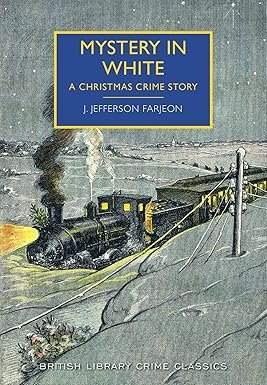
I always like to have a suitable Christmassy read at this festive time, so I’ve chosen this book which is described on the front cover as ‘A Christmas Crime Story’ so I think I’ve chosen well! It’s set on Christmas Eve and on a steam train in heavy snow, so that’s three ticks of things I love just from the blurb on the back of the book, I can’t wait to dive in! I enjoyed the author’s imaginative plotting in his book The Z Murders, so I’m anticipating a good read with this book too. Grab your copy and let’s read it together!
The 11.37am Euston to Manchester train is halted due to heavy snow blocking the line, and the guard tells the passengers that he has no idea when the train will be able to move again. The occupants of the carriage are siblings David and Lydia Carrington, Jessie Noyes (a chorus girl), Mr Thomson (a young clerk), Mr Hopkins (a traveller keen to relate his experiences, and nicknamed ‘the elderly bore’ by the Carringtons), and Edward Maltby (a member of the Royal Psychical Society. David and Lydia and Jessie discuss leaving the train in order to cut across the fields to the station of Hemmersby in the hope that another branch line leading from there might be open and they can then continue to their destinations. As they are discussing this, Maltby suddenly stares out of the window, and the others, following his gaze, think they see a figure out there. Maltby then jumps up and leaves the train. Oooh, who was the figure out in the snow, and why did Maltby feel a need to follow him? And I love that the details of the route and departure time of the train are included as it just makes it all feel so much more realistic. And of course this book is written in the 1930s so it’s a steam train which is just adorably nostalgic, perfect for Christmas! I also love how there used to be carriages on trains too, though I guess there was the chance of being stuck for the journey with someone you find annoying (as some of the occupants of this carriage have found with the man they’d nicknamed ‘The Elderly Bore’!).
David and Lydia and Jessie, with Thomson, then also leave the train, partly because they are worried about Maltby being out in the snow as he is an elderly man, partly because they can’t stand being left with Hopkins, and partly because they prefer action to sitting and waiting for the train to move. They soon realise that the snow is far deeper than they’d imagined, and it also begins snowing again so they become lost and increasingly scared. They had followed Maltby’s footprints in the snow for some time but these are now being covered up by the fresh snow falling. Jessie trips and sprains her ankle and then faints, David having to pick her up and carry her, and all of them becoming desperate for some kind of shelter, realising the danger they are now in and being unsure of the way back to the train. Thomson then stumbles upon a front door, to everyone’s delight. They knock at the door and ring the bell but there is no answer, then they push the door and it opens, as it is unlocked. They fall into the house in relief, noting the lit fire in the hearth and a striking portrait on the wall of a very stern-looking elderly man with piercing eyes, but no-one comes to their shouts. They begin exploring the ground floor looking for the residents, and note that the kettle is boiling and the table is set for tea and there are also fires lit in the other rooms, but still no-one seems to be about which they puzzle over as it is unlikely that anyone would venture outside in these conditions and yet someone must have been there very recently. They then find a bread-knife on the kitchen floor, and when David ventures upstairs to search for someone there he hears a noise when he knocks on the locked attic door. Ooooh, I’m loving this already, how delicious, the signs of very recent occupation in the house with the boiling kettle and the table set for tea and yet no-one is there, it’s so wonderfully creepy and also very clever to use such ordinary innocent things (the kettle and the tea table) which then become potentially sinister! And of course, that was before the bread-knife on the floor and the noise behind the locked door, both of which are definitely sinister, eeek!
They all begin to feel a little worried at the oddness of the house being empty yet with the signs that someone was recently there, but all are determined not to share their feelings of alarm with the others in order to prevent the shared alarm increasing. Thomson goes to make tea for everyone as they all realise the need to get themselves warm and dry, but he picks up the bread-knife gingerly so as to preserve any possible fingerprints on it, having a vague feeling that there might have been a crime committed with it. David goes back to the attic room to investigate the noise behind the door (which he had told the others was probably a mouse), and there is no noise now when he knocks at the door but he finds that the door is now unlocked. When David returns to the ground floor, he finds Maltby and another man there, both covered in snow and having found the house and entered it just like they had. They fill Maltby in on how the house was when they found it, including the bread-knife, and Maltby immediately asks if they touched the knife and if they could have destroyed the murderer’s fingerprints, causing horrified reactions from the others and accusations that he is being overly-dramatic speaking about a murder. They ask the name of the other man, who pauses and then says his name is Smith, but he angrily corrects their assumption that he was on the train with them, saying he was just out for a walk and adding that he intends to leave now. As he walks to the front door, a train ticket falls onto the floor which Maltby picks up and looks at and sees it is a ticket for their Euston to Manchester train, and hands this to Smith, who angrily denies that it is his ticket and promptly leaves. As the front door begins to close behind Smith, the people inside hear shouts for help from outside so David and Thomson immediately go outside to help and eventually find Hopkins and bring him back to the house. Oooh, I think I’d be alarmed at the oddness of the house too, and eeeek the attic door is now unlocked, omg, this is really sinister now as it seems like there is indeed someone in the house with them but who wants to conceal their presence for some reason! And clearly Smith is a suspicious character wanting to conceal his identity and his purpose there…the mysteries grow and grow deliciously, as the snow builds up and up outside the house too, so we have the claustrophobia of being trapped inside the house as well as the awkwardness of them all being strangers thrown together in an emergency and not knowing if what each tell about themselves is actually the truth and if they can be trusted! It feels like Maltby is going to be in charge of this situation though, he seems a comforting if somewhat blunt figure.
Jessie rests in bed, as does Thomson as he has flu. Hopkins tells the group that he left the train because a body of a man was discovered in the next carriage to them, and they all discuss this as they eat the tea and warm themselves by the fire and get changed into dry clothes, vowing to leave money for the owner of the house to replace what they’ve used. Smith comes back to the house. Maltby tells David he suspects that it was Smith in the attic, that he climbed out of the window when David knocked but there is something in the attic he wants which has caused him to now come back to the house again. Maltby also adds that he believes that Smith was on their train. The snow increases and is banked up against the outer doors so they now can’t leave, and they also realise there is no telephone in the house. Hopkins comes downstairs (after resting due to his soaking in the snow) and meets Smith for the first time. He says he recognises Smith from the train, but backs down on this when faced with Smith’s aggressive denial. Omg, so there was a murder on the train! There seems to be suspicious things everywhere we turn, on the train and in the house, and the characters from the train are now all in the house, this is very clever! And I wonder if Smith was the one who murdered the man on the train and who then left the train and who Maltby tried to follow. He certainly seems a volatile character though, very defensive but not very good at concealing this.
Lydia suggests assigning roles to everyone, to help them get through this strange situation, eg, someone to be the cook, someone to keep a list of all the items they use so they can leave the money value of these later, and someone to arrange some kind of Christmas festivities for them all. Meanwhile Hopkins and Smith bicker at each other, until Hopkins accuses Smith of murdering the man on the train. Smith then attacks Hopkins and tries to strangle him, but is pulled off by David and Maltby. Smith grabs a knife and runs out of the room, and then out of the kitchen window. As Maltby and David shut the kitchen window after Smith’s exit, they hear a shriek from outside which Maltby thinks is Smith, and then proceeds to tell David that he imagines Smith has tripped over the body buried in the snow which he himself tripped over on his arrival but at the time presumed was just a log, but he has now, given the missing residents of the house, decided must be a body. Eeeek, there is a dead body in the snow, omg! And the casual way that Maltby shares these things, and how long has this information been in his mind too? He is a deep man! I feel a little relieved that Smith has now left the house, he was definitely a loose cannon, I initially thought it was the bread-knife he’d grabbed (the one presumed to already be a murder weapon) as that would seem to be fitting, and would add to the menace, but when I look back I think it was just ‘a knife from the table’. And I’m aware we haven’t gone back to Thomson for a long time, is anyone checking on him (like Lydia is frequently checking on Jessie)? Has he been killed?! Or is he actually a suspicious character pretending to be sick and is actually walking around outside hurting people (and was this why Smith shrieked, as Thomson attacked him?) or creeping around inside gathering information or weapons for his own purpose?
Maltby tells David and Hopkins that he has accumulated three pieces of evidence, a hammer which he found near the house partially covered in snow thereby suggesting it hadn’t been there long, a black letter-case containing a card with the name WT Barling and some money which he found in the attic, and a torn envelope and letter which he found in the bin in the room occupied by Thomson. He deducts that the owner of the letter-case was the man on the train that Smith murdered in order to steal the money within, though Maltby thinks Smith may not have been aware that he’d killed Barling but suspected he had seriously hurt him so this is why he escaped the train, though now Smith does know that he killed Barling which has made him even more desperate to escape. Maltby adds that he presumes Smith kept returning to the house as he wanted the letter-case he’d left in the attic when he escaped out of the window at David’s knock on the door. Maltby says that the torn envelope and letter appear to have been written from the master of the house to his servant Charles Shaw letting him know that he and his daughter would be arriving on the evening of Christmas Eve, so Maltby presumes that they arrived and something then happened between the three people resulting in the dead body outside in the snow, and that the hammer was probably the weapon used for the killing. Maltby goes on to wonder if Shaw was perhaps affected by loneliness being here in the house on his own, and perhaps could have felt that the portrait of the elderly man was watching him. David initially points out that the tea things were laid out for an afternoon meal not an evening one so this wouldn’t seem to fit with the proposed evening arrival time of the master and his daughter, but he then wonders if perhaps the weather changed their plans and they arrived earlier. Maltby says that when he was approaching the house he saw two figures through the snow, one being a woman, but he then bumped into Smith (when Smith had made his first get-away from the attic window) so couldn’t focus on the other two figures any longer at that time. Maltby also tells David and Hopkins that he has now put away the bread knife to keep it safe. Hmmm, so we’ve learnt quite a lot there then. There seems to be two unrelated murders that have happened this afternoon, the murder of Barling by Smith in the train, and the murder of either the master or Shaw by one of the three in the house (I am guessing the daughter can’t be the body in the snow as Maltby saw two figures through the snow and he thought one was a woman). Hmmm, is this too coincidental, there being two murders in one afternoon? And is it also coincidental that murderer No.1 (Smith) ended up at the same house where murder No.2 (the body in the snow) was committed? Are these murders actually related in some way, rather than being coincidences? Though I can’t really see how the two murders or murderers can be related. And I am loving the partly torn letter so you have to try and guess the full contents, that’s such a delicious element of murder mystery stories, isn’t it? And we keep coming back to this sinister portrait of the elderly man on the wall, don’t we?
David announces that he must go and deal with the body in the snow, though the others question why. He climbs out of the kitchen window, as the snow is banked up too highly against the front and back doors for him to exit that way. When outside, he sees two sets of footprints in the snow. He presumes that one set is Smith’s, and follows one set which goes all around the house and up to the back door. He quickly checks for any footprints leading to the kitchen window to ensure that no-one has entered the house that way since he left that point, and there aren’t any footprints to indicate this but he does see footprints nearby which he is certain weren’t there when he exited the window a few moments ago so guesses that someone was stood close by in the snow watching him walk around the house. He finds the buried body but then doubts how he would dig it up and what to do with it, so decides instead to follow the footprints. The two sets of footprints diverge at a fork, he follows one set which leads him to a car stuck in the snow containing the master of the house and his daughter, William Strange and Nora. Nora explains to David that they were heading to Valley House (and David realises this is the name of the house they are all at), but their luggage was lost at the station so they decided to stay at an inn at Hemmersby, also thinking of the worsening weather, but then her father suddenly decided that they would go to Valley House that day so borrowed a car to do so and then the car got stuck in the snow. She adds that her father seemed to then go into a dreamlike state, and keeps falling asleep. She also says that a man (David presumes this was Smith, from her description) passed by their stranded car and promised to get help for them but hasn’t yet returned. David explains about them all having taken shelter at Valley House, and adds that their servant Shaw isn’t there at the house, and he guides them back to the house. William collapses when they reach the house, and he is put into Jessie’s room now she has moved downstairs. Hmmm, I did wonder myself what on earth David was going to do with the dead body in the snow, he surely wasn’t going to bring it into the house, so why bother at all and put himself in danger when he knows Smith is out there with a knife? Perhaps he did just want to be respectful to the dead person, but really this all seems a bit impulsive and badly-thought-out by him, I hadn’t really seen those characteristics in him but perhaps he felt obliged to prove himself useful in some way with Maltby doing all the detecting, and perhaps the claustrophobia and tension inside the house wasn’t making him act naturally. I have just flicked back to see if it was him who impulsively decided to leave the train so therefore confirming that he is an impulsive person, but I see it was actually Lydia who made that suggestion and he in fact cautioned her about the continuing falling snow, so that seems to show that he isn’t particularly impulsive and continues to make me ponder about his action here insisting on retrieving the body. But oooh, I love the footprints in the snow and the unidentified and potentially mysterious figures they belong to, another delicious element of murder mystery stories, we are being treated to a great suspenseful story by the author! And so now we have William and Nora joining the gang in Valley House, I’m sure it will be interesting to get their story.
Meanwhile, Jessie shares with the others that she was experiencing visions and feelings of being poisoned or dying when she was in the bed upstairs. Maltby suspects she has spiritual abilities so asks her to shut her eyes and he then puts the hammer to her head asking her for her thoughts while she is unaware of what he is doing, and she talks about a hammer being used to kill someone. Meanwhile Lydia goes to check on Thomson and finds him gone, he then stumbles downstairs, hallucinating, and then collapses, so he is brought into the drawing room downstairs with the others. When David returns with William and Nora, he tells Maltby and Hopkins about the footprints and Maltby is concerned why the person he himself saw when he arrived at the house had stayed nearby all these hours, he feels that this therefore implies that they badly want something inside the house and he also therefore thinks they are likely to try and return for it. Nora gives her story to the group, she says this is the first time she has visited Valley House, she thinks the portrait on the wall is her grandfather John Strange as he looks like her father, and she says that her grandfather died about 20 years ago. She says that her father and his brother Harvey lived here with her grandfather, and then her father went off to fight in the war but that Harvey found a reason for avoiding doing war service, and she adds that her father and Harvey hate each other and haven’t met for years. She says her father proposed marriage to her mother during the war and brought his bride to Valley House at Christmas in 1916, but her grandfather wouldn’t give his approval to this marriage and turned them out of the house and cut her father out of his will so Harvey would inherit everything, although as her father was the eldest son he automatically inherited the house due to the entail. Their servant Charles Shaw was at Valley House at the time, and has been with the family for 40 years. She herself was born while her father was back on the Front, but he got shell-shock after the war and has never fully recovered from it, often going into the dreamlike states as he did when their car was stranded. She continues that her grandfather fell ill with a heart condition in October 1917, but suddenly wrote inviting her father and mother to Valley House on Christmas Eve of that year saying he had a surprise for them, but he died after coming down the stairs to greet them on their arrival and before he could tell them why he had summoned them there. She adds that her Uncle Harvey and her grandfather’s nurse Martha and his doctor Dr Wick were at the house at the time, as well as Shaw. Maltby asks at what time of day her grandfather died, and she says at exactly 2am on Christmas Day, 20 years ago, and Maltby begins to wonder if her grandfather will somehow try to send them a message in an hour’s time at 2am on Christmas Day. Nora continues with her story, saying that her uncle continued living at Valley House and soon got through all the money he had inherited and she doesn’t know where he is now. She adds that she thinks her father received a letter a few days ago and this prompted him to return to the house he had never been back to since her grandfather died. Hmmm, well, the Stranges’ story is interesting and I am presuming there are links back to the present time, though I’m not sure I’m fully onboard with the ghostly feelings that Maltby seems to favour, and Jessie too seems to be spiritually-inclined as well, it makes me wonder if this story will go down the supernatural route rather than the murder mystery route. Although, thinking about it, this isn’t really feeling like a ‘proper’ murder mystery whodunnit, as the reader is having the tale unfolded to them at the same time as the group in the house learn things so there isn’t really an opportunity for us to guess ahead at what will be revealed or try to follow clues to guess the murderer (although I certainly keep trying to do so, tee hee!), and I see in the blurb on the back of the book that Dorothy Sayers describes Farjeon as being ‘quite unsurpassed for creepy skill in mysterious adventures’, so perhaps this creepiness which is creeping in (tee hee!) is more Farjeon’s preferred style of writing rather than murder mystery whodunnit. And (going back to my attempts to guess clues, even though the reader doesn’t seem to be encouraged to do so) it looks like I was incorrectly suspicious about Thomson as he does seem to be suffering seriously from flu rather than wandering about inside or outside the house potentially killing people, tee hee! And (still attempting to guess things!) I wonder if Smith could be Uncle Harvey? I guess I am holding onto the idea that there must be a link between the train passengers and Valley House as I am reluctant to believe that it was just chance that led them there to Valley House and all the drama going on inside, surely one of them had a reason to be there and is involved in some way? Though I guess the snow grounding the train at that spot couldn’t have been predicted, so perhaps I’m wrong but I’ve been waiting for a surprise reveal that one of the train passengers is actually someone linked with Valley House.
Maltby notices that the snow has now stopped so he suggests that the lights are turned off and they wait to see if the person who has been outside the house for so long then tries to enter the house through the kitchen window he has opened, while he and David and Hopkins place themselves on the other side of the kitchen door in order to catch the person. While they wait, he tells them that he found another letter in Shaw’s room (when Thomson, who had been staying in that room, knocked over a cabinet when he had his fit). He says the letter is from the nurse Martha, who is actually Shaw’s sister, and she was writing in response to his letter to her telling of William and Nora’s imminent visit to Valley House. In her letter, Martha refers to her husband, Dr Wick, who has recently died, saying she suspects that he wrote to William before he died telling him something that John Strange had shared with him all those years ago and which she suspects relates to money being hidden in Valley House. Martha also says in her letter that Harvey was with her when Shaw’s letter arrived so he has also insisted on being at Valley House for William and Nora’s arrival, and she also refers to the fact that Harvey is saying that he would prefer to tell people the secret and to take the consequences of that rather than allow himself to continue to be blackmailed by them, so she suggests that they kill Harvey at Valley House and leave William to be blamed for the killing. Maltby reminds David and Hopkins that this means Martha and Harvey have been near Valley House that day, along with Shaw, and that it is probably this incriminating letter that Martha or Shaw want to return to the house to get hold of. He then asks Nora to try and find the letter that her father received from Dr Wick, so they can hopefully discover the secret that the doctor revealed. She finds the letter and they read it while they continue to wait for the person to enter the house. The letter is anonymous but refers to the writer as a ‘he’ and that he will shortly die, the letter says that John Strange had decided to leave his money to William when he was nearing the end of his life so he converted £5000 of his investments into cash and hid it, although he didn’t tell the writer of the letter where he had hidden this cash, but as the money was intended for William then the writer suggests he comes to Valley House to search for it. Oooh, I’m loving all the information gained from these letters! So I’m guessing that Harvey’s secret, for which he’s being blackmailed by Martha and Shaw, is that he killed his father, John Strange. And it’s also seeming likely that it is Harvey’s body buried in the snow. And how exciting that there is a fortune hidden in the house somewhere! I wonder if William’s knowledge of his father will give him a clue as to where he was likely to have hidden it, as obviously Shaw and Martha and Harvey have never found it during the 20 years that John Strange has been dead (if they suspected its existence all that time, of course). And eeek, the tension is mounting beautifully while we’re waiting for this person to enter the house! And I wonder who will enter, Martha or Shaw (or even Harvey, if he’s not the dead body in the snow)? Or could it be Smith again, still keen to try and get the letter-case?
Shaw enters the house through the kitchen window, and David and Hopkins and Maltby catch him. Maltby accuses him of murdering John Strange and Harvey, but Shaw denies this. He says that 20 years ago Martha realised that John Strange was softening towards William and likely to alter his will to benefit William rather than Harvey so she suggested to Harvey that they kill the elderly man by poisoning him, in order to prevent him altering his will, and in return she wanted a share of Harvey’s inheritance. He says that after John Strange had died Martha found his altered will (which benefited William) hidden inside his wig, so she then kept this and used it to blackmail Harvey for further money, threatening to present the altered will if he didn’t pay up which would mean that he would lose the money he’d inherited. Shaw insists that he had nothing to do with the poisoning plan and he only found out about it afterwards, and that the only gain he was promised then was that Harvey would keep him in his job at Valley House. Shaw adds that when John Strange was still alive Martha had been having an affair with Dr Wick when they were nurse and doctor to John Strange, and that she forced Dr Wick to marry her and to not say anything about the poison in John Strange’s body when he wrote the death certificate, otherwise she would ruin his practice by revealing their affair. Shaw goes on to say that all three of them had been searching the house that afternoon for the money they suspected was hidden there but hadn’t found it, and that Harvey had then got drunk and stated again that he wouldn’t be blackmailed any longer, resulting in Harvey and Martha quarrelling and Harvey storming out of the house, to be followed by Martha who then killed him with the hammer. Shaw adds that when Martha told him what she’d done, they both decided to flee the house but soon got lost in the snow and also then realised that they’d left behind her incriminating letter to him, but by the time they found the house again in the snow they could see people were inside the house so they took shelter in the barn waiting for a chance to later enter the house and retrieve the letter. He says however that they later heard a shriek which terrified Martha who then left the barn and didn’t return, so he eventually went out searching for her and saw her approaching a car stranded in the snow, he heard her speak to the occupant of the car and realised that she thought it was him hiding in the car as she told the occupant to come out otherwise she’d call the police and blame the killing on him, and then he saw the occupant of the car reach out and stab and kill her. Maltby guesses that the man in the car was Smith, and that he had instinctively presumed that Martha was referring to his killing of Barling on the train so immediately decided to silence her by killing her. Hmmm, so there seems to be quite a few coincidences here with both murderers (Martha and Smith) leaving incriminating evidence inside Valley House and wanting to get back into the house to retrieve it! I guess they were both in a pressured situation, having murdered people, but would they both be that careless? Although I can see that them having to keep coming back to the house allows the wonderful storylines of tension with the inhabitants of the house feeling slightly under siege with unknown and potentially dangerous people prowling outside, otherwise all we’d have is the mystery of why the house was empty, but hmmm it seems a bit of a stretch! And there seems to be quite a few coincidences with this stranded car too, with everyone seeming to stumble across it, I’m just thinking that the snow was so fierce and blinding that at times people couldn’t find the house but they all seemed to find this car, tee hee! So if I’ve got this straight in my head, William and Nora crashed their car, Smith found them in the car and promised to get help for them and then left them, meanwhile Martha had left the barn, meanwhile David had left the house and found the car and rescued William and Nora, then Smith came back to the empty car and got inside it (and I have another point about this, which I’ll add below after this), and then Martha found the car and thought her brother was inside it so made threats which Smith took to be threats directed at him so he killed her. There’s an awful lot of coming and going with this car! And (this is my other point) I wonder what Smith was going to do with William and Nora when he went back to the stranded car and why he had gone back to the car in the first place, did he want to use it as shelter or hoped he could move it out of the snow and then drive away from the area, in which case if they had still been inside the car would he have forced them out of it or killed them, or just asked them if he could also shelter inside with them and take them away with him if he managed to get the car moving? Or did he not really plan to end up back at the car but just got lost in the snow and found himself there again (which is then another convenient coincidence to add to the growing number of people stumbling across this car!)? Obviously all this isn’t a criticism, I love all these coincidences in murder mystery books, they are part of the fun and are often necessary to the plot so I’m quite happy to suspend disbelief, plus I also enjoy dissecting these coincidences afterwards!
William wakes up and insists on going downstairs. It is now four minutes to 2am on Christmas Day (2am being the time when John Strange died 20 years ago), and William seems to be expecting something to happen at 2am, as does Maltby. As the clock strikes 2am, Maltby turns out the lamp and shines a light on the portrait of John Strange and then speaks as John Strange, saying that the money is hidden behind the portrait. Later when the snow has dispersed and the inhabitants of the house are rescued, they learn from the police that they had been searching for Smith after finding Barling’s body on the train and that a police officer had found him at the edge of Webber’s Dip and tried to arrest him, resulting in Smith fighting with the police officer and then falling over the edge to his death. The police conclude that Smith killed Harvey and Martha because he was desperate and insane. Maltby tells David that it has occurred to him that Shaw could have possibly killed Martha but that he has now discounted this as he thinks Shaw doesn’t really seem the type to kill. William shares with Maltby that he has decided to believe Shaw’s plea that he wasn’t involved in his father’s murder, and that as his father’s murderers (Harvey and Martha) are now both dead then he feels it is not worth asking the police to investigate the murder and risk the family name being shamed. David and Nora declare their love for each other.
Awww, so there’s a happy ending with David and Nora in love! But really, all of this hangs on Shaw’s word, doesn’t it, and with both Martha and Harvey dead there is no-one to contradict his version of events. I was intrigued by Maltby’s thought that Shaw may have killed Martha and I’ve mulled that over for a time wondering if that was the case (even though Maltby seemed to discount it), if he did kill her then did he follow her to the car and kill her there (although surely he wouldn’t do this with Smith in the car watching him, and he clearly didn’t kill Smith to prevent him saying anything as Smith was later seen by the police officer falling into Webber’s Dip), or did he kill her elsewhere and for some reason drag her to beside the car and leave her there (although why, and surely there would then be tracks in the snow), and presumably she was killed with the knife that Smith had taken from the house so Shaw could have only got hold of this knife if Smith had dropped it (and surely it’s too much coincidence to have a dropped hammer and a dropped knife in the snow!). So, tempted though I am to find an extra little mystery, I think perhaps it must have been Smith who killed Martha (it’s just convenient that Smith can’t give his version of events!).
And going back to dropped weapons, why did Martha drop the hammer after killing Harvey, which Maltby later found in the snow? I guess she perhaps couldn’t risk being found with it, and perhaps if she’d used gloves when handling it then she was confident that there were no clues to her identity on the knife, but it just seems like potential evidence (and therefore risk) laying around for someone to find, when she could have disposed of it far from the house as she’d obviously initially intended to remove herself from the area after the killing (until she realised she’d left behind the incriminating letter). And staying with dropped weapons, why was the bread-knife on the kitchen floor? It wasn’t actually used to kill anyone, was it, even though the inhabitants of the house feared it had been used for this purpose and this increased their fear of being in the house? So was it just dropped by Shaw, when he and Martha fled the house, but why did they leave the house so swiftly that he had no time to place the bread-knife on the table, I can’t really imagine it was the shock of Harvey’s death as this wasn’t an unplanned killing (as Martha had said in her letter to her brother that she was intending to do this, so they both knew it was going to happen), or was it perhaps that they heard Smith entering the house so this is what caused them to swiftly leave the house, though there was no reason why they should fear that this intruder would suspect them of murder, or perhaps did they think it was William and Nora and so therefore wanted them to be the ones alone at the house and therefore suspected of Harvey’s death? I guess overall, I’m slightly disappointed that after the bread-knife seemed such a deliciously menacing and mysterious item it actually ended up as meaning nothing, just a red-herring! But red-herrings are delicious parts of this murder mystery genre, frustrating though they can be at times!
And before I leave the role of convenient coincidences in this book…so there were two sets of murders and murderers all on the same day, Smith murdered the man in the train for his money and then later murdered Martha as he thought she was going to call the police, and Martha murdered Harvey. So two murderers floating around in the snow in the same area having both murdered people for unconnected reasons on exactly the same day, hmmm, that does stretch the imagination a little, I think! And I also feel it stretches the imagination a bit (as I’ve said before regarding the finding of the stranded car) to believe that in the blinding snow so many people randomly found Valley House, first Smith, then David and the others, then Maltby, then Hopkins, all independently of the others! I was tempted to think that some followed the footprints in the snow of the others but it sounded like this can’t have been the case really as the snow was falling too heavily so surely covering up any footprints. But, as I say, these coincidences are all very adorable within such a great story and inevitable within this (my favourite) genre!
And I’m also wondering about the point of Thomson in the story (although I’m aware I probably sound a little harsh here!)? He wasn’t there for most of the action and surmises, so I’m tempted to think that he could have been easily left out altogether without affecting the story in any way, even he seems to be doubting his value at the end when he asks Jessie if he’s made a fool of himself and she tries to reassure him that she’s sure he would have helped if he’d been well. The only contribution I can think he provided was that he knocked over the drawer of the cabinet in his fit which then allowed Maltby to find Martha’s letter to Shaw, but Maltby could have quite easily just found this letter anyway when he was searching around. Or was Thomson there in order to be an eventual partner for Jessie, as I think it was implied at the end that they got together (although I wasn’t quite sure about this, it didn’t seem very definitely stated)? But it may well be that I’ve missed things in the book which answer this question, and my other questions above, and I’m always tempted to re-read a murder mystery when I’ve finished it just in the hope of discovering these answers, so I’ll probably do that.
And one last question (!), I was intrigued with Maltby’s quote towards the end of the book of ‘how separate drops of water merge into communal obedience to a mass of dead matter called the moon, and go for six hours one way and then for six hours another’, using this to demonstrate the forces of nature that we don’t understand. So what does he mean by this, is it just relating to spiritualism and ghosts, or something more to do with the case that he knows or suspects but hasn’t shared? I guess him pretending to be John Strange’s voice was very odd and again gave a spiritual/ghostly kind of link through the story which comes back again to the ‘creepy’ element of the author’s writing that Dorothy Sayers referred to, so perhaps it is just a reference to spiritualism and ghosts, and of course nature is amazing which is always worthwhile to point out.
I very much enjoyed this book, it ticked so many of the festive and mysterious boxes, it was all I’d hoped for and I loved every minute of reading it! I’ll look out for more books by this author, and also other festive murder mystery books. I see Farjeon wrote No. 17 which was adapted by Alfred Hitchcock so I imagine that would be good to read, and some interesting titles of his I see listed on Wikipedia which sound intriguing are The House of Disappearance, and The 5.18 Mystery, and Death in Fancy Dress. And I’m still in the mood for more festive reads, so I’ve picked up Janice Hallett’s The Christmas Appeal, but I’m also thinking about re-reading Agatha Christie’s The Adventure of the Christmas Pudding, and Charles Dickens’ A Christmas Carol, and I recently remembered that I used to love the Frost detective series by RD Wingfield and one of those books is Frost At Christmas which seems appropriate too for a festive re-read.